
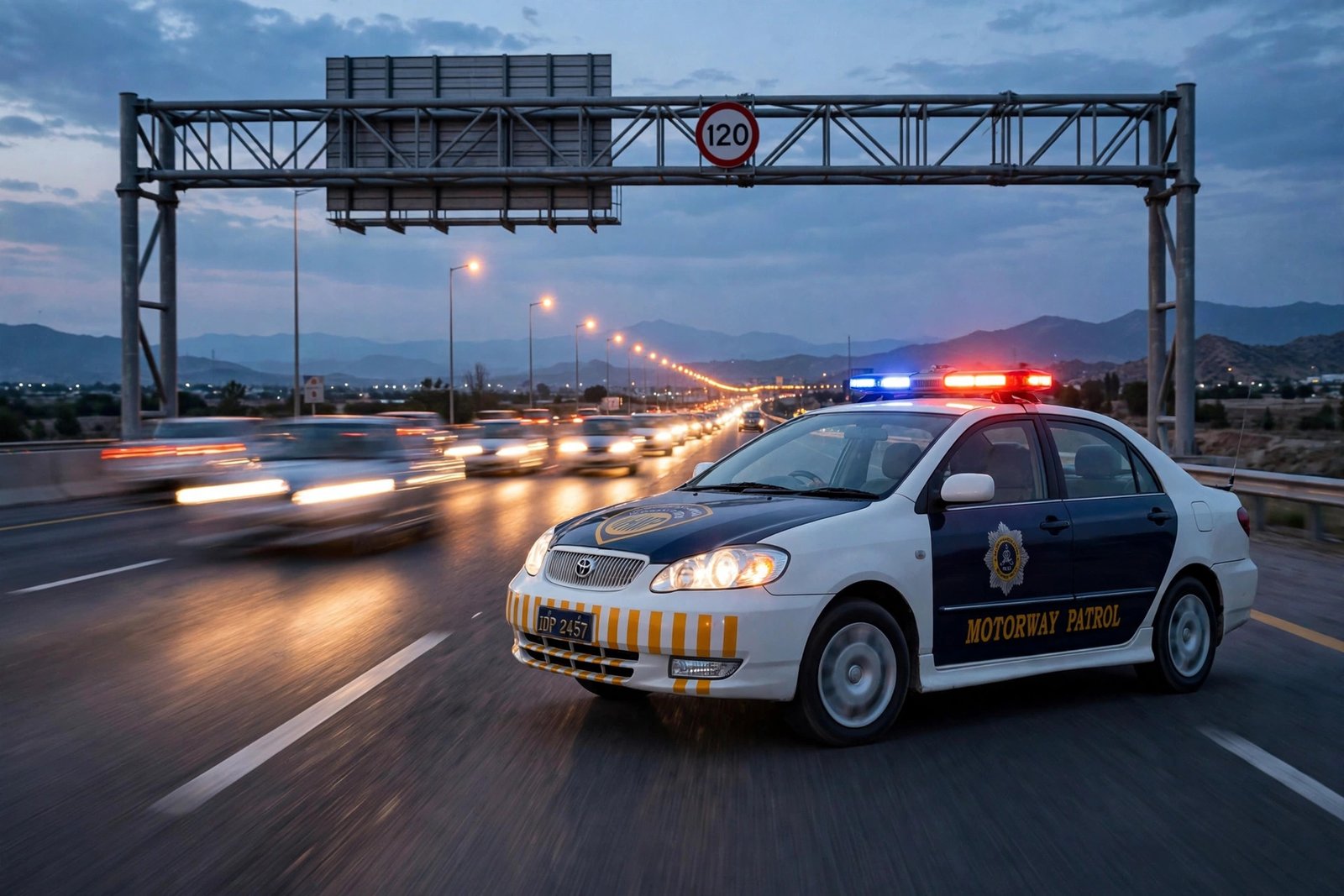
Quick Answer: What Is the Motorway Speed Limit in Pakistan Right Now?
As of June 21, 2026, the motorway speed limit in Pakistan is back to 120 km/h for cars and light transport vehicles and 110 km/h for buses, coaches, wagons and trucks. On national highways it is 100 km/h for cars and 80 km/h for heavy vehicles. A speeding ticket on the motorway costs a car driver Rs 2,500.
If you drove the M-2 between Lahore and Islamabad this year, you probably lived through the confusion first-hand. In March the limits dropped. In June they came back. Some drivers are still paying fines for tickets they got during the cut — and a few of those tickets were issued wrongly. This guide tells you the current law, what a challan really costs, and exactly how to fight one you don't deserve.
Why Did the Speed Limit Change Twice in a Single Year?
Because the government changed its mind. On March 12, 2026, speed limits on motorways were cut by 20 km/h across the board — down to 100 km/h for cars and 90 km/h for heavy vehicles. The stated reason was fuel saving: slower traffic burns less fuel, and Pakistan's fuel import bill was bleeding.
Drivers hated it. Transporters hated it more. A 120-to-100 cut turned a five-hour Lahore–Islamabad run into something noticeably longer, and on the long M-5 Multan–Sukkur stretch the difference was painful.
So the cut was withdrawn. On June 21, 2026, the National Highways and Motorway Police (NHMP) restored the previous limits: 120 km/h for cars and light transport vehicles, 110 km/h for public service vehicles and heavy transport vehicles. If anyone tells you the limit is still 100, their information is three months out of date.
What Are the Current Speed Limits on Motorways and Highways?
Motorways: who gets 120 and who gets 110?
- Cars and light transport vehicles (LTVs): 120 km/h
- Public service vehicles (PSVs) — buses, coaches, wagons: 110 km/h
- Heavy transport vehicles (HTVs) — trucks, trailers, oil tankers: 110 km/h
These apply on all motorways: M-1 (Islamabad–Peshawar), M-2 (Lahore–Islamabad), M-3, M-4, M-5, and the newer sections. The category matters. A Suzuki Bolan is an LTV — 120. A 22-wheeler trailer is an HTV — 110. Driving a truck at 118 is speeding even though a car beside it at 118 is perfectly legal.
National highways: lower than you think
- Cars: 100 km/h
- Heavy vehicles: 80 km/h
The N-5 (the old Grand Trunk Road) is not a motorway. Neither are the N-55 or the Karachi–Hyderabad superhighway sections that aren't motorway-grade. People get caught here all the time: they leave the M-2 at 120, merge onto a highway, keep doing 120, and collect a challan. Different road, different law.
Minimum speeds: yes, too slow is also an offence
This surprises people. The law sets a minimum of 65 km/h on a rural motorway. Crawling along at 50 in the fast lane because you're nervous is not just dangerous — it's an offence. Motorways are built for continuous flow. A car doing half the speed of traffic is a moving hazard, and the Motorway Police can ticket you for it.
The rule that overrides everything: the sign in front of you
The national limits are the default. A posted sign always wins. Near toll plazas the limit drops to 30–40 km/h. Around interchanges and sharp curves it's lower. In road-work zones with orange cones, expect 60 or 80. During fog season in Punjab, the NHMP imposes temporary limits — sometimes as low as 50–60 km/h with fog lights mandatory — and those temporary signs have full legal force.
So the real rule is two lines long: know the default, obey the sign. A driver doing 110 past a sign that says 80 is speeding, no matter what the national limit says.
Which Law Actually Gives the Motorway Police This Power?
The National Highways Safety Ordinance, 2000. This is the governing law for everything on Pakistan's national highways and motorways — speed, lane discipline, overloading, the works.
Its Fifth Schedule sets the ceiling the authorities must work within:
- Rural motorway: maximum 130 km/h
- Urban motorway: maximum 110 km/h
- Rural motorway: minimum 65 km/h
Read that carefully. The Ordinance itself allows up to 130 on a rural motorway, but the NHMP's notified limit is 120 — the notified limit is what binds you, not the ceiling. And the 110 cap for urban motorways explains why some city-adjacent stretches feel slower than the open M-2.
Mere tajurbe me aksar drivers sirf is liye haar jate hain ke unhein pata hi nahi hota ke kaun sa qanoon un par lagoo hai. When you know it's the 2000 Ordinance and the NHMP's notified schedule — not some officer's personal mood — you argue from a position of strength.
How Much Is a Speeding Fine on the Motorway?
For a car driver, a speeding ticket from the Motorway Police costs Rs 2,500. That is the standard figure. One ticket, one offence, Rs 2,500.
What about buses and trucks? Their fines are set higher under the challaning schedule — the exact figure depends on the vehicle class and the offence. I won't quote a number I can't verify; the point is that heavy-vehicle fines run noticeably steeper than the car figure, and overloading or lane violations stacked on top of speeding push the total up further.
Pay once and it's done. The trouble starts when you don't pay — more on that below.
How Does the Motorway Police Actually Catch Speeders?
Not by guesswork. The NHMP uses three main tools, and understanding them matters if you ever contest a ticket.
1. Handheld radar guns. A patrol officer points the gun at traffic from an overhead bridge or a marked spot on the shoulder. The reading locks in seconds. This is the most common method — and the one most open to challenge, because a handheld reading depends on the officer aiming at the right vehicle.
2. Fixed speed cameras. Mounted at known overspeeding hotspots and sector boundaries. These photograph the number plate and record the speed. The challan then goes to the registered owner of the vehicle — which is why sold-but-not-transferred cars cause so much misery.
3. Patrol interception. An NHMP vehicle paces you or clocks you, then pulls you over at the next safe point. The officer issues a paper challan on the spot.
Here's the scenario that fills my inbox: Kashif was driving his Corolla from Lahore to Islamabad on the M-2. Cruise control set at 118. Near Kallar Kahar, a camera flashed. Two weeks later a challan arrived at his registered address — 127 km/h in a 120 zone, fine Rs 2,500. But Kashif had a dashcam. His footage showed 117 on the speedometer at the exact timestamp of the ticket, and his toll-plaza entry and exit times proved an average speed well under the limit. He contested it — and won. Evidence beats paperwork. Remember that.
I Got a Challan. Where Do I Check It and How Do I Pay?
First, don't panic — and don't throw it away. A challan you pretend doesn't exist is far worse than a challan you pay.
Checking: You can verify a motorway challan through the NHMP's official channels, including its helpline 130, or by visiting the NHMP sector/beat office that issued it. If the challan came by post, the issuing sector and officer details are printed on it.
Paying: Challans are payable at designated bank branches and through the NHMP's online challan system. Pay before the due date printed on the ticket. Keep the paid receipt — photograph it, keep the paper, do both. I have seen drivers pay a challan, lose the receipt, and get stopped for the same "unpaid" ticket a year later. The receipt is your shield; keep it at least a year, ideally two.
Can you pay late? Usually yes, but late payment can attract additional charges and the unpaid challan sits against the vehicle's record in the meantime. If you plan to contest, pay nothing yet — but start the contest process immediately, before the due date passes.
How Do You Contest a Wrong Speeding Ticket? Step by Step
Wrong tickets happen. Radar guns mis-aim. Cameras misread plates (a dusty "8" becomes a "3"). Sometimes the officer tickets the wrong car in a pack. Here is the process that actually works.
Step 1: Stay calm at the roadside
Do not argue with the officer on the shoulder of the M-2. Nothing good has ever come from a shouting match at 120 km/h traffic. Accept the challan paper. Note the officer's name, rank, belt/sector number, and the exact location and time. If you believe it's wrong, you can note your disagreement politely — then fight it on paper, where you can win.
Step 2: Collect your evidence fast
Evidence goes stale. Within 24–48 hours, gather:
- Dashcam footage showing your speedometer at the ticket time — the single strongest evidence there is
- Toll plaza entry/exit timestamps — the M-2's toll system records when you entered and exited; the average speed between two plazas is simple maths an officer cannot argue with
- GPS trip logs from Google Maps timeline or your car's tracker
- Photos of the speed sign at that sector — was it visible, or hidden behind a truck, a tree, or construction hoarding?
- A second witness if someone was in the car with you
Kashif's case (the M-2 driver above) was won on toll timestamps plus dashcam. The average-speed maths made the camera's 127 km/h reading impossible, and the ticket was cancelled.
Step 3: File at the right office
Take a written application to the NHMP sector/beat office that issued the challan — or the designated traffic adjudication office for that sector. Address it to the sector commander or the competent NHMP officer. Keep it short: your name, CNIC, vehicle number, challan number and date, why the ticket is wrong, and what evidence you attach. Get a receiving stamp or diary number on your copy. No diary number, no proof you filed.
File before the challan's due date. Once a challan is long overdue, cancellation becomes much harder — the system treats it as admitted.
Step 4: The hearing
You'll get a date. Show up, on time, with originals of everything. Present the maths simply: "Sir, I entered at 14:02 and exited at 16:47, 233 km in 2 hours 45 minutes — average 84 km/h. The camera says 127. Both can't be true." Officers respect clean numbers. The decision is usually one of three: cancelled, reduced, or upheld.
Step 5: If the decision goes against you
You can take the matter to the competent court or magistrate that tries offences under the National Highways Safety Ordinance, 2000. This is where it stops being a roadside argument and becomes a proper legal proceeding — and where having a lawyer actually matters. For guidance on how challan disputes play out in the adjudication system, see our detailed piece on disputing traffic fines: /articles/25-e-challan-traffic-fine-dispute-pakistan.php. And if the cost of a lawyer is what holds you back, don't let it — /articles/27-free-legal-aid-pakistan.php explains where to get free legal help in Pakistan.
Can One Challan Snowball Into a Real Legal Problem?
Usually, no. A single Rs 2,500 speeding ticket, paid on time, is a closed chapter. It doesn't go on some permanent criminal record. It won't show up in a police verification.
But challans do accumulate on the vehicle's record, and habitual unpaid fines create real friction — blocked vehicle transfers at Excise & Taxation, renewal problems, and being flagged at toll plazas. And extreme speeding is a different animal: triple-digit excess over the limit, racing, or reckless driving that endangers others can land you before a magistrate under the Ordinance, with penalties far beyond a fine. In the genuinely extreme cases — dangerous driving that causes injury — the matter can turn criminal, and then you need to understand /articles/08-bail-process-pakistan.php rather than this guide.
The honest summary: one paid challan is nothing. A habit of ignoring them is something. Reckless driving is something else entirely.
What Happens If You Just Ignore the Challan?
Short version: it doesn't go away. It waits.
The unpaid challan stays linked to the vehicle's registration number. The next time you're stopped at a toll plaza or a checkpoint, it pops up. The amount can grow with late-payment additions. And when you try to sell the car, the buyer (or the Excise & Taxation office) will find the pending challans during transfer — Sana from Rawalpindi learned this the expensive way. She ignored three motorway challans totalling less than Rs 8,000, then couldn't transfer her sold Cultus for weeks until every rupee was cleared with penalties on top. The buyer nearly walked away from the deal.
In persistent cases the NHMP can also move the matter toward the competent court, which means summons instead of a simple fine. A Rs 2,500 problem becomes a take-a-day-off-work problem. Pay it or fight it — but don't ignore it.
Motorway Driving Tips That Keep You Out of Trouble
- Set cruise control at 115, not 120. Speedometers have error margins, downhill stretches add speed, and 115 gives you a buffer against both. The drivers who never get tickets are the ones who leave a margin.
- Trucks left, cars right — actually follow this. Lane discipline isn't a suggestion on motorways; the NHMP tickets for it, and the fast lane at 65 km/h is how pile-ups start.
- Slow down before the sign, not at it. Cameras sit near limit-change points. Brake early.
- Fog season (November to February in Punjab) is the danger window. Use fog lights, follow temporary limits, and if visibility drops below safe levels, the NHMP may close sections — check before you leave, not after you're inside the fog.
- Check tyres before long runs. A blowout at 120 on the M-5 is a different event from a blowout at 60 in the city. Pressure, tread, spare — five minutes at a petrol pump.
- Rest every two hours. The M-2 has proper rest areas; use them. Fatigue at motorway speed kills more people than speeding tickets ever will.
- Seatbelts for everyone, including the back seat. It's the law, and it's the single cheapest life insurance ever invented.
Common Mistakes Pakistani Drivers Make
Assuming 120 everywhere. The M-2's open stretch is 120. The toll plaza approach is 30. The interchange ramp is lower still. Most tickets are issued in the transition zones, not the open road.
Setting cruise to exactly 120. See the buffer point above. Exactly 120 plus a downhill plus a speedometer that's 3% optimistic equals a ticket.
Driving at 55 in the right lane "to be safe." You're not being safe — you're a rolling roadblock, and you're breaking the 65 km/h minimum. Nervous drivers belong in the left lane at a steady 80–90.
Selling a car without clearing challans. The challans follow the registration number, not you. Clear them before transfer, or hand the buyer a written, dated record of what's pending.
Throwing away paid receipts. Digital systems glitch. Paper doesn't. Keep receipts two years.
Arguing at the roadside. The officer on the shoulder cannot cancel a ticket — the sector office can. Save your energy for the forum that has the power.
Believing cameras are "just for show." They're not. The fixed cameras on the M-2 and M-4 issue thousands of challans a month, mailed straight to registered owners.
Documents Checklist
Keep in the car, always
- Valid driving licence (original, not a photo — though keep a photo as backup)
- Vehicle registration book or smart card
- CNIC
- Valid vehicle insurance documents
- Any paid challan receipts from the last two years
Keep ready if you're contesting a ticket
- The original challan (both sides photographed)
- Dashcam footage covering the ticket time, saved to a separate file
- Toll plaza entry/exit receipts or SMS timestamps
- GPS trip log screenshots with timestamps
- Photos of the speed signage at the location
- Your written application with the office diary/receiving number
- CNIC copy and vehicle documents
Frequently Asked Questions
Is the motorway speed limit really 120 km/h again in 2026?
Yes. The 20 km/h cut imposed on March 12, 2026 was withdrawn, and on June 21, 2026 the NHMP restored the old limits: 120 km/h for cars and light transport vehicles, 110 km/h for buses, coaches, wagons and trucks. If a sign still shows the old reduced figure, photograph it — but the notified national limit is back to 120/110.
How much is a speeding fine on the motorway?
Rs 2,500 for a car driver — that's the standard Motorway Police speeding ticket. Fines for buses, trucks and other heavy vehicles are set higher under the challaning schedule. Whatever the amount, pay before the due date or contest it before the due date; ignoring it only makes it grow.
Can I contest a motorway challan online?
There is no reliable fully-online cancellation system — don't trust random websites claiming otherwise. The working route is a written application to the NHMP sector office that issued the challan, with your evidence attached, followed by a short hearing. Start by calling helpline 130 to confirm which office holds your ticket.
What evidence works best against a wrong ticket?
Dashcam footage with a visible speedometer, and toll-plaza entry/exit timestamps proving your average speed. Together they're nearly unbeatable: if the maths says you averaged 90 km/h between two plazas, a camera claiming 130 at one point becomes very hard to defend. GPS logs and photos of obscured signs help too.
How long do I have to pay a challan?
The due date is printed on the challan itself — treat it as a hard deadline. Pay at designated banks or through the NHMP's challan system before it passes. If you're contesting, file your application well before the due date so the ticket is under review, not overdue.
Does a speeding challan affect my driving licence?
A single paid challan doesn't cancel or suspend your licence. But unpaid challans pile up against the vehicle's record and cause problems at Excise & Taxation during registration renewal or transfer. Extreme or repeated reckless driving is a different matter — that can put you before a magistrate, where the stakes are much higher than Rs 2,500.
Can I really be fined for driving too slowly?
Yes. The National Highways Safety Ordinance's Fifth Schedule sets a 65 km/h minimum on rural motorways, and the Motorway Police do ticket drivers crawling in fast lanes. If you're not comfortable at motorway pace, stay left, keep a steady 80–90, and let faster traffic pass. Slow in the wrong lane is genuinely dangerous.
What if the camera caught the wrong car — a misread number plate?
It happens more than people think, especially with dusty or damaged plates. Compare the challan's vehicle description, colour and location with your car. If you were in another city that day, prove it — fuel receipts, toll records from elsewhere, CCTV, anything timestamped. A plate-misread case with an alibi is one of the easiest tickets to get cancelled.
Final Word
The 2026 saga — cut in March, restored in June — left a lot of drivers unsure what the law actually is. Now you know: 120 for cars, 110 for heavy vehicles, 100/80 on highways, signs override everything, and a car speeding ticket is Rs 2,500 under the National Highways Safety Ordinance, 2000.
And if a ticket lands on you unfairly? Don't argue on the shoulder. Collect your evidence, write your application, and fight it where it counts. The system does cancel wrong challans — Kashif's did — but only for drivers who show up with proof instead of just complaints.