
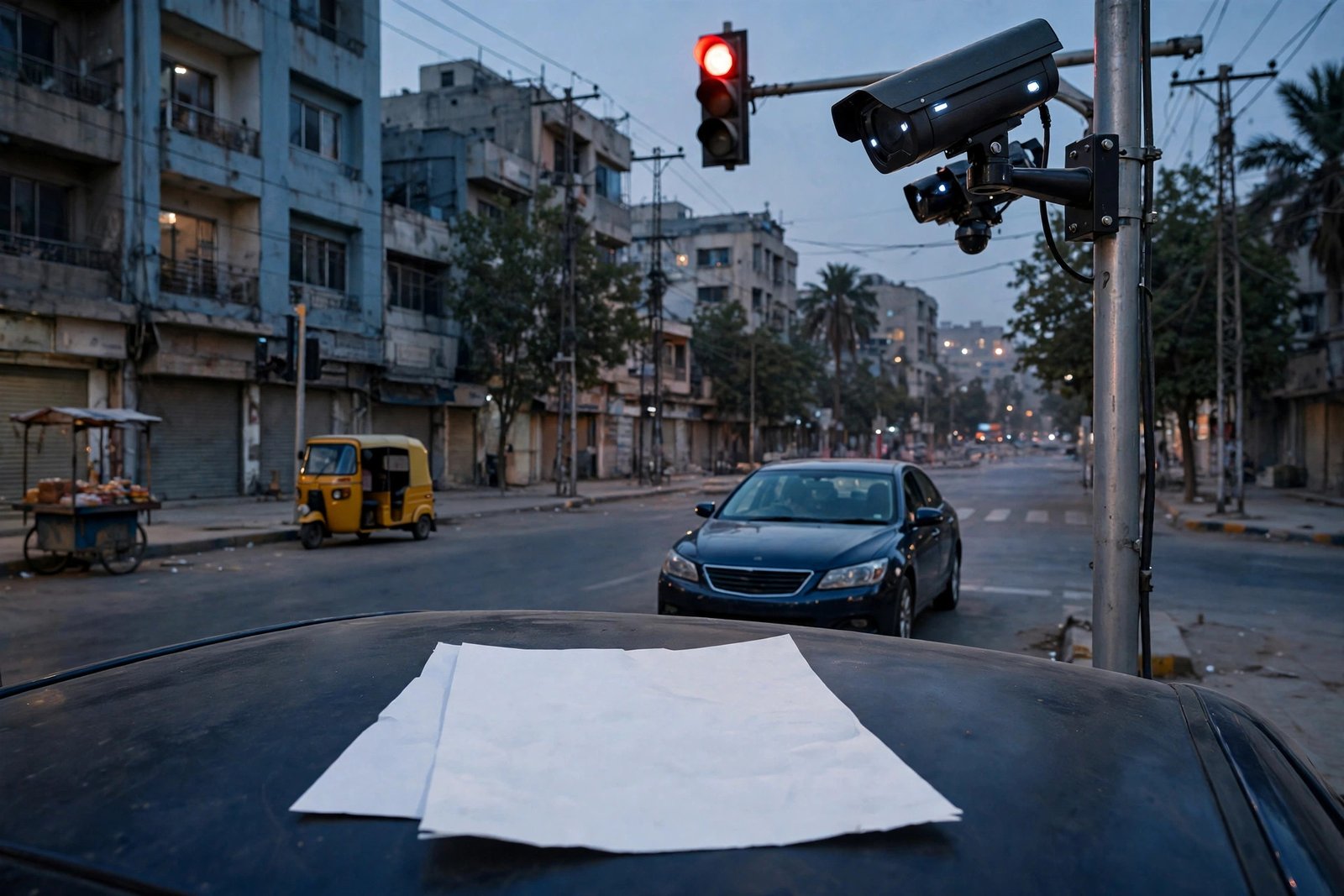
Traffic E-Challan in Karachi & Pakistan: Check, Pay & Legally Contest a Wrong Fine
Quick answer: An e-challan is a camera-based traffic fine under the Motor Vehicle Ordinance 1965 and provincial rules. Karachi's come via the Safe City network and the Sindh Traffic Police e-ticketing system. Check it on the official portal, pay through banking channels, or contest it at the traffic office or before the magistrate. Ignore it and it can block your vehicle's transfer.
You are driving home from work on Shahrah-e-Faisal. A week later, an SMS arrives: your car has been fined for "red signal violation." You were sure you stopped. Now what? Pay quietly, or fight it? This guide walks you through the whole system — what an e-challan is, how to check it, how to pay it, and — most importantly — how to legally contest it when the camera got it wrong.
What Exactly Is an E-Challan — and Who Issues It?
An e-challan is a traffic fine generated electronically, without a traffic policeman stopping you. Cameras mounted at intersections and along main roads photograph your number plate when a violation happens: running a red light, over-speeding, wrong-way driving, not wearing a seatbelt, using a mobile phone while driving. The image is processed, the plate number is matched against the vehicle registration record, and a challan is issued against the registered owner.
The legal basis is the Motor Vehicle Ordinance 1965 and the provincial Motor Vehicle Rules made under it. These laws define the traffic offences and the penalties. The cameras and software only detect the offence; the punishment power comes from the Ordinance.
In Karachi, e-challans come through the camera network run under the Safe City / Safe Cities authority system, processed through the Sindh Traffic Police's e-ticketing setup. In Punjab, the Punjab Safe Cities Authority (PSCA) runs the system, which is why Lahoris have been dealing with e-challans the longest. Islamabad has its own camera-based enforcement too. Different authority, same legal foundation.
Is an e-challan as "real" as a hand-written challan?
Yes. It carries the same legal weight. The fact that no officer handed it to you does not make it optional. It goes into the system against your vehicle's registration, and it has to be settled — by payment or by a successful contest — before it stops haunting you.
How Do I Check If My Vehicle Has an E-Challan?
There are a few reliable ways. Use the official channel, not random third-party websites that want your details for nothing.
1. The official traffic police portal. The Sindh Traffic Police maintains an e-challan checking facility where you enter your vehicle's registration number and see unpaid challans with dates, offence types, locations, and images. Punjab's PSCA has its own portal and mobile app. For Islamabad, the Islamabad Traffic Police's site carries the equivalent facility. I am deliberately not printing URLs here — portals get redesigned and old links die, which causes more confusion than help. Search for the official portal of your province's traffic police, verify it is a government domain, and check there.
2. SMS alerts. Once issued, the challan SMS usually goes to the mobile number registered with the vehicle. This is exactly why keeping your registered mobile number updated at the Excise & Taxation office matters — and it is one of the most common mistakes I see. People buy a car, never update the contact details, and discover six challans a year later.
3. Visit the traffic police office. Every city has a designated e-challan help desk or facilitation centre where staff check your record on the spot. Bring your original CNIC and vehicle documents. This takes 30–45 minutes in most cases, including the queue.
Check your record at least once a month if you drive in a city with cameras. It takes two minutes and saves you from nasty surprises.
Step-by-Step: How to Pay an E-Challan
So you have checked and the challan looks correct — yes, that was your car, and yes, you did cut that signal on a rainy night in August. Fine. Paying is the easy part, and here is the process:
Step 1 — Confirm the details. Note the challan number, the offence, the date and time, and the location shown. Compare the photo with your own memory or records. If the plate in the photo is not yours or the image is unreadable, stop here — you are in contest territory, not payment territory.
Step 2 — Choose a payment channel. E-challans are payable through the standard banking channels the traffic police accept: the issuing authority's designated bank branches, ATM and internet banking of partner banks, and mobile banking apps that list traffic challan payment. The challan itself, and the official portal, name the current accepted channels.
Step 3 — Keep the receipt. Screenshot it. Save the PDF. Print a copy if you are the careful type. Keep it for at least a year. Payment records in government systems occasionally lag — a paid challan can show as unpaid for a few days or even weeks. Your receipt is your proof. Without it, you are at the mercy of the database.
Timeline: once you pay through an accepted channel, the record typically clears within 24–72 hours. If it still shows unpaid after a week, take your receipt to the traffic police help desk and get it reconciled. Do not just pay a second time — get the first payment recorded.
Step-by-Step: How to Contest a Wrong E-Challan
Now the important part. Cameras misread plates. Dust, glare, bent number plates, and lookalike registrations ("B" read as "8", "0" read as "D") produce wrong challans. Vehicles sold but not transferred generate challans against the old owner. I have seen all of it in practice.
Step 1 — Do not pay first. This sounds obvious, but it is the single most common error. Payment is treated as an admission. Once you pay, getting a refund or reversal is a bureaucratic battle you do not want. Check, doubt, contest — in that order.
Step 2 — Gather your evidence. Pull together everything that shows the challan is wrong:
- The photo/video still attached to the challan (download or print it)
- Your own evidence: dashcam footage if you have it, fuel receipts, toll receipts, parking slips, or GPS/location records proving where you actually were
- Proof of vehicle ownership and registration (book/transfer letter)
- If the vehicle was sold: the sale agreement and transfer application, dated before the challan date
- If it is a plate misread: clear photos of your actual number plate
Step 3 — Visit the traffic police e-challan office. Go to the designated office in your city with originals and two photocopy sets. Ask for the challan verification / complaint section. Explain, in writing, what is wrong: plate misread, wrong vehicle, vehicle already sold, image unclear, location you never visited. File the complaint and take a diary number / receipt number. This number is your lifeline — everything after this references it.
Step 4 — Follow up. Visit or call after 10–15 working days with your diary number. In many cases, especially plate misreads and double entries, the office cancels the challan at this stage. Mere tajurbe me aksar yahi hota hai: agar evidence saaf hai to complaint stage par hi challan kharij ho jata hai — court tak jane ki zaroorat nahi parti. Keep your tone calm and factual. The staff at these desks deal with hundreds of people; the ones who get results are the ones with organised files, not raised voices.
Step 5 — The traffic magistrate / challan court route. If the office rejects your complaint, you can take it to the traffic magistrate or the challan court that has jurisdiction over the place of the alleged offence. You present your case — the challan record, your evidence, your earlier complaint and its diary number. The magistrate hears both sides and can cancel the challan, uphold it, or reduce the fine where the law allows. This is a proper judicial forum, not an internal review, and its decision settles the matter.
Step 6 — Keep records forever. Whatever the outcome, keep the diary number, complaint copies, receipts, and the court's order (if any) in one file with your vehicle documents. Challans have been known to reappear after transfers or system upgrades.
Can I hire a lawyer for this?
For a straightforward plate misread, you usually do not need one — the help-desk route resolves most. For a disputed challan that has reached the magistrate, or where the amount involved is significant, a traffic-matter lawyer is worth it. If cost is the concern, look into the options described in our guide on free legal aid in Pakistan.
What Happens If I Just Ignore the E-Challan?
This is the question I hear most often in my office, usually asked hopefully. The honest answer: nothing good.
The fine does not expire. It sits against your vehicle's registration record. Under the Motor Vehicle Ordinance and provincial rules, unpaid fines can lead to escalated recovery — the amount you owe can grow as penalties compound, depending on the province's rules.
It blocks transfers. This is the one that actually bites. When you go to the Excise & Taxation office to transfer the car to a buyer — or when the buyer tries to register it — unpaid e-challans surface in the clearance check. The transfer gets held up until the dues are cleared. Imagine this scene: you have sold your car, the buyer is standing at the Excise office, and three old challans you ignored appear on the screen. The deal stalls, the buyer loses trust, and in a hot market you can lose the sale entirely.
It flags the vehicle on the road. Enforcement teams can check challan status on the spot. A vehicle with outstanding fines can be stopped, and in some cases detained, until dues are settled.
It follows the registered owner, not just the driver. Sold the car but did not transfer it? The challans keep coming to you. This is why transferring immediately after sale is not a courtesy — it is self-defence. A proper written legal notice to the buyer demanding transfer can also protect you if they delay.
So: ignoring is the most expensive option on the menu. Check monthly, pay what is correct, contest what is not.
Are E-Challan Fine Amounts the Same Everywhere?
No — and this matters. Fine amounts vary by province because the Motor Vehicle Ordinance is implemented through provincial rules and schedules. Over-speeding, red-signal jumping, driving without a licence, and wrong-way driving each carry penalties set by the relevant province's Motor Vehicle Rules, and these are revised from time to time.
I am deliberately not printing a fine schedule here. The figures change, and a stale schedule on a website helps no one. The correct figure is always the one printed on your challan and shown on the official portal. If a challan's amount looks different from what you expected, that is a legitimate question to raise at the help desk — but the schedule on the challan itself is the governing document, not a blog's table.
Common Mistakes That Cost Drivers Money
- Paying before verifying. Treat every challan as a claim, not a fact. Payment is admission. Check the photo first.
- Never updating contact details after buying a vehicle. The SMS alerts go to the old owner, and fines pile up silently. Update your mobile number at Excise when you transfer.
- Driving on an untransferred vehicle. If you bought the car but the registration still shows the seller, challans go to them — or worse, you have no standing to contest. Transfer promptly.
- Throwing away payment receipts. Keep every challan receipt for at least a year. The system lags; your receipt does not.
- Ignoring small fines. They do not go away. They wait — and they ambush you at the Excise office on transfer day.
- Arguing with cameras via random websites. Use only the official portal and the designated offices. Third-party "check your challan" sites harvest your data and sometimes display outdated information.
- Confusing a legal notice with a challan. A challan is a government penalty. If instead you receive a demand or notice from a private party about a traffic incident, that is a different animal — see our guide on how to file an FIR if an incident involved a crime.
Documents Checklist
Keep this file ready — whether you are paying, contesting, or transferring:
- Vehicle registration book / smart card — original plus two photocopies
- CNIC of the registered owner — original plus two photocopies
- E-challan printout or screenshot — challan number, date, offence, location visible
- Payment receipts (if paid) — bank receipt, screenshot, or SMS confirmation
- Complaint diary number (if contested) — the receipt from the traffic police office
- Evidence bundle (if contested) — challan photo, your counter-evidence, dated and organised
- Sale agreement and transfer application (if the vehicle was sold) — dated proof of transfer
- Number plate photographs — clear front and rear, in case of a misread dispute
A folder with these eight items makes you the easiest citizen the help desk will deal with all week. And easy citizens get faster results.
Real Situations, Real Fixes
Ahmed, Gulshan-e-Iqbal, Karachi. Ahmed received three e-challans in a single month for red-signal violations at an intersection he swore he never used. He went to the help desk with his documents, and the officer pulled up the photos. The plate in the images ended in "786"; Ahmed's ended in "789". A camera misread, plain and simple. He filed a written complaint with the photos attached, got a diary number, and all three were cancelled within three weeks. His mistake? He had ignored the first two SMS alerts because he assumed they were spam.
Sana, DHA Phase 5, Karachi. Sana sold her Suzuki Swift to a relative in January. The relative kept delaying the transfer — "next week, next week." By April, Sana had received five e-challans for over-speeding on the Superhighway. She paid none of them. Instead, she went to the help desk with the sale agreement, the dated transfer application, and bank records showing the payment received in January. The office linked the evidence, and the challans were marked against the new owner's pending transfer file instead of hers. Then she made sure the transfer completed that same month. Lesson: sell with a deadline, in writing.
Bilal, North Nazimabad, Karachi. Bilal's car was photographed running a red light at 2 a.m. near Teen Talwar. The photo was his car, no question. But Bilal had lent the car to his cousin that night — who had, in fact, jumped the signal and admitted it. Bilal paid the challan (it was correct, after all) — but not before a useful realisation: the challan follows the registered owner, not whoever was driving. He now has a standing rule in the family: borrow the car, and any challan is on you. Written down. Signed. Aksar log ye ghalti karte hain — they lend the car casually and absorb someone else's fine silently.
Frequently Asked Questions
Q1. What is an e-challan, in simple words? It is a traffic fine issued electronically when a camera catches your vehicle committing an offence — like jumping a red light or over-speeding. It is issued under the Motor Vehicle Ordinance 1965 and provincial rules, carries the same legal weight as a hand-written challan, and is recorded against your vehicle's registration until you pay it or get it cancelled.
Q2. How can I check my e-challan in Karachi? Use the Sindh Traffic Police's official e-challan portal and enter your registration number, or visit a designated traffic police help desk with your CNIC and vehicle documents. You will also usually receive an SMS on the mobile number registered with your vehicle — which is why keeping that number updated at Excise is so important.
Q3. Can I pay an e-challan online? Yes. E-challans are payable through the accepted banking channels — designated bank branches, ATM, internet banking, and mobile banking apps of partner banks. The challan and the official portal name the current channels. Always keep the payment receipt for at least a year in case the system record lags behind.
Q4. The challan is wrong — my car was not there. What do I do? Do not pay it. Payment counts as admission. Gather your evidence — the challan photo, anything proving where you or the vehicle actually were — and file a written complaint at the traffic police e-challan office. Take the diary number. Most genuine errors, like plate misreads, are cancelled at this stage within a couple of weeks.
Q5. What if the traffic police office rejects my complaint? Then you take it to the traffic magistrate or the challan court for the area where the offence was allegedly committed. Present the challan, your evidence, and your earlier complaint with its diary number. The magistrate hears the matter and can cancel the challan, uphold it, or reduce the fine where the law allows. It is a proper judicial forum.
Q6. I sold my car but challans keep coming to me. Why? Because the registration still shows you as the owner. Challans follow the registered owner, not the driver. Go to the Excise & Taxation office and complete the transfer immediately. For challans issued after the sale date, take your sale agreement and dated transfer application to the traffic police office — they can be re-attributed.
Q7. What happens if I never pay an e-challan? The fine stays on your vehicle's record and can escalate under provincial rules. The real pinch comes at the Excise office: unpaid challans block or delay vehicle transfers, which can kill a sale. Enforcement teams can also stop a flagged vehicle on the road. Ignoring is genuinely the most expensive option.
Q8. Are e-challan fines the same in Karachi, Lahore and Islamabad? No. Fine amounts are set by each province's Motor Vehicle Rules, so Karachi, Lahore, and Islamabad can differ — and amounts are revised over time. Always go by the figure printed on your challan and shown on the official portal, not by tables you saw online last year.
Q9. Can someone else's driving get me an e-challan? Yes — the challan is issued against the registered owner's vehicle, regardless of who was behind the wheel. If you lend your car, any camera-caught offence lands on your record. Sort out the reimbursement privately with the driver; the state's claim is against you.
Q10. Do I need a lawyer to contest an e-challan? For a clear error like a plate misread, the traffic police help-desk route usually resolves it without a lawyer. If the matter reaches the traffic magistrate, or the stakes are high, legal help is worthwhile. If affordability is the issue, read our guide on free legal aid in Pakistan before assuming you cannot get help.
The Bottom Line
The e-challan system is not your enemy. It has caught genuine reckless driving that no patrol could have been everywhere to catch. But it is a machine, and machines misread plates, lag on payments, and cannot tell that you sold the car six months ago.
So treat it the way you would treat any official claim against you: check it monthly, pay what is genuinely yours, and contest what is not — with evidence, in writing, through the proper forum. A folder with your vehicle documents, receipts, and any complaint diary numbers is the cheapest insurance a driver in Karachi can own. And one last question for you: when did you last check your vehicle's record? If the answer is "never," today is the day.