
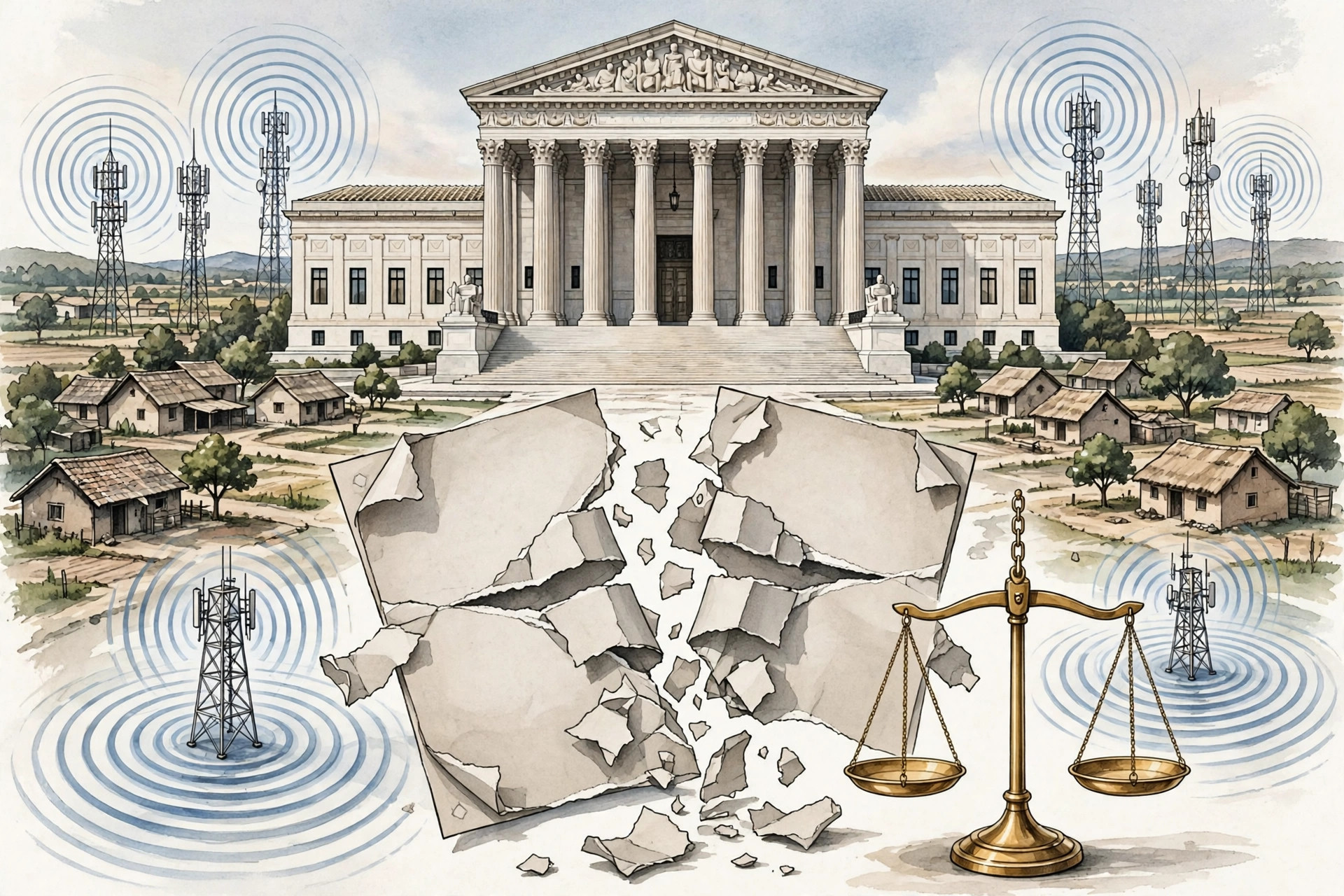
In late October 2026, the Supreme Court of Pakistan set aside a tax demand of Rs 4.79 billion raised against the Universal Service Fund (USF), ruling that the fund's payments to telecom companies for services in underserved areas are not subject to tax deduction at source under Section 153(2)(b) of the Income Tax Ordinance, 2001. The USF described the decision as an important step toward the government's "Digital Pakistan" vision, crediting the guidance of the Ministry of IT and Telecommunication (MoITT) and the Pakistan Telecommunication Authority (PTA).
This article explains, in plain language, what the ruling was about, what Section 153(2)(b) does, why the Court said the USF's payments fall outside it, and what the decision means for the telecom companies building Pakistan's rural networks — and for anyone who pays withholding tax on services in Pakistan.
What Is the Universal Service Fund?
The Universal Service Fund is a public fund created under Pakistan's telecom framework to bring connectivity to areas where commercial telecom operators would not go on their own. Mobile companies and other operators contribute to the fund; the fund then disburses money — subsidies and project payments — to telecom companies that build and operate networks in underserved and unserved areas of the country: remote districts, mountainous regions, and border areas where the business case for a new tower does not add up.
The USF is not a commercial buyer of services in the ordinary sense. It does not hire a telecom company the way a business hires an advertising agency. It disburses public money to make rural connectivity financially viable. That distinction turned out to be decisive in the Supreme Court.
What Is Section 153(2)(b)?
Section 153 of the Income Tax Ordinance, 2001 is Pakistan's workhorse provision for withholding tax on payments for goods and services. In plain terms, it requires certain payers — called "specified persons" or "prescribed persons" (companies, government bodies, and other designated entities) — to deduct tax at source when they make payments to others for the supply of goods, the rendering of services, or the execution of contracts.
Clause (b) of subsection (2) deals specifically with payments for services. The logic is familiar to anyone who has received a professional fee in Pakistan: the payer deducts a percentage and deposits it with the FBR, and the payee gets credit for it against their final tax liability. Withholding is a collection mechanism — it collects the tax early, from the person receiving the payment.
The tax authorities' position in the USF case was, in essence: the USF is a payer making payments to telecom companies, and those payments are for services, so withholding under Section 153(2)(b) applies. The resulting demand was Rs 4.79 billion — a figure large enough to threaten the fund's entire subsidy programme.
Why the Supreme Court Said No
The Court's reasoning, as reported, turned on the true character of the USF's payments. Withholding under Section 153(2)(b) applies to payments for services rendered to the payer — a commercial exchange where one party buys services from another. The USF's disbursements are subsidies paid out of a public fund to support the provision of telecom services in areas the market would otherwise ignore. The fund is not purchasing services for its own use or benefit in the commercial sense; it is executing a public-policy mandate.
This matters because tax law looks at substance, not labels. If a payment is in substance a subsidy or grant disbursed under a statutory universal-service programme, it does not become a "payment for services" simply because money changes hands and work gets done. The telecom companies receiving the money are indeed building networks and providing services — but they are providing them to the public in underserved areas, not to the USF as a customer.
The Court therefore set aside the tax order issued by the revenue authorities, deciding the matter in the USF's favour. (The composition of the bench and the case number could not be independently confirmed at the time of writing; readers should treat those details as unreported rather than established.)
Who Bears the Economic Effect?
It is worth understanding where a Rs 4.79 billion withholding demand would actually land. Withholding taxes are, by design, collected from the payee — deducted from the payment and credited against the payee's own tax. If the USF had been required to withhold under Section 153(2)(b), the Rs 4.79 billion would have been carved out of the subsidy payments flowing to the telecom companies building rural networks.
That would have had a direct policy consequence: less money reaching the companies laying towers in remote districts, or the same money at a higher administrative cost. The whole point of the USF is to close the connectivity gap where the market fails. A tax demand of this size on the fund's disbursements would have worked against that purpose — which is presumably why the USF framed the ruling as a win for the Digital Pakistan vision.
What This Means for Businesses That Pay Withholding Tax
The ruling does not rewrite Section 153 — it clarifies its boundaries. Three practical takeaways:
- Character of the payment matters. Not every payment that accompanies services is a "payment for services" under Section 153(2)(b). Grants, subsidies, and statutory disbursements made in furtherance of a public mandate stand on different footing from commercial service contracts. If your organisation disburses public or donor funds, the legal character of each payment — not just the fact that work was done — determines the withholding obligation.
- "Specified persons" still withhold on genuine service payments. The decision does not give companies or government bodies a general excuse to stop deducting tax on service payments. Ordinary commercial payments for services remain squarely within Section 153(2)(b). Misreading this ruling as a blanket exemption would invite penalties.
- Document the nature of your payments. The USF won because the nature of its fund and its statutory mandate were clear. Organisations making subsidy-type payments should keep the governing instruments — the statute, the fund rules, the project agreements — organised and ready, because the first question in any withholding dispute is always: what, legally, was this payment?
The Digital Pakistan Angle
The USF's statement credited MoITT and PTA guidance, and the subtext is worth noting. Pakistan's universal-service programme has connected hundreds of previously unserved mauzas and thousands of kilometres of national highways and motorways over the years. Every rupee of the fund that goes to the exchequer as withholding on its own disbursements is a rupee not spent on a tower in a remote tehsil.
The Supreme Court's decision removes a Rs 4.79 billion cloud from the programme. For the telecom companies operating in hard areas, it means subsidy receipts arrive intact. For policymakers, it is a reminder that tax administration and sectoral policy need to be read together — a withholding demand that is technically aggressive can be strategically self-defeating.
What to Watch Next
Two things are worth watching. First, whether the FBR seeks review of the decision or issues clarificatory guidance on the treatment of subsidy-type payments under Section 153 — a ruling like this often prompts the department to tighten its internal instructions. Second, whether similar disputes surface in other sectors where public funds disburse subsidies to private operators (energy, agriculture, and housing all have analogous programmes). The reasoning of this case — substance over form, mandate over label — will be cited in all of them.
For now, the law as it stands after this ruling is: payments by the Universal Service Fund to telecom companies for services in underserved areas are not subject to deduction at source under Section 153(2)(b) of the Income Tax Ordinance, 2001, and the Rs 4.79 billion demand built on that premise has been set aside.
Frequently Asked Questions
Q: I am a small business that pays freelancers for services. Does this ruling mean I can stop deducting withholding tax? A: A: No. This ruling is about the specific character of the Universal Service Fund's subsidy disbursements under a statutory universal-service mandate. Ordinary commercial payments for services — hiring a freelancer, an agency, a contractor — remain subject to withholding under Section 153. Do not treat this decision as a general exemption.
Q: What exactly is "withholding tax" under Section 153? A: A: It is tax collected at the source of a payment. When a specified person (a company, government body, or other prescribed payer) pays for goods, services, or contracts, it must deduct a prescribed percentage and deposit it with the FBR. The person receiving the payment gets credit for the deducted amount against their final income-tax liability. It is a collection mechanism, not an extra tax.
Q: The article mentions the bench composition is unconfirmed. Why does that matter? A: A: In Pakistani legal reporting, the bench that decided a case and the case citation are how lawyers verify and cite a ruling. Because this decision was reported through a single news source at the time of writing, those formal details could not be independently confirmed. The core holding — the quashing of the Rs 4.79 billion demand on Section 153(2)(b) grounds — is what was reported; the formal citation details should be checked against the Supreme Court's own cause lists and judgment uploads before citing the case in court filings.
Q: Could the FBR challenge this decision? A: A: The department has the usual appellate and review remedies available under the law. Whether it exercises them is a matter for the FBR. What matters for readers is the law as it stands now: the demand has been set aside, and subsidy-type disbursements under a statutory mandate are outside Section 153(2)(b) on the Court's reasoning.
Q: Does this affect the telecom companies' own income tax? A: A: Not directly. The ruling is about whether the USF must deduct tax at source when disbursing subsidies. The telecom companies' own income-tax liability on their profits is a separate matter, assessed on their returns in the normal way. Withholding is only the collection mechanism; removing the withholding obligation does not exempt anyone's income from tax.
The Bottom Line
This article provides general legal information for readers in Pakistan and is not legal advice. For advice about your own situation, consult a qualified advocate.