
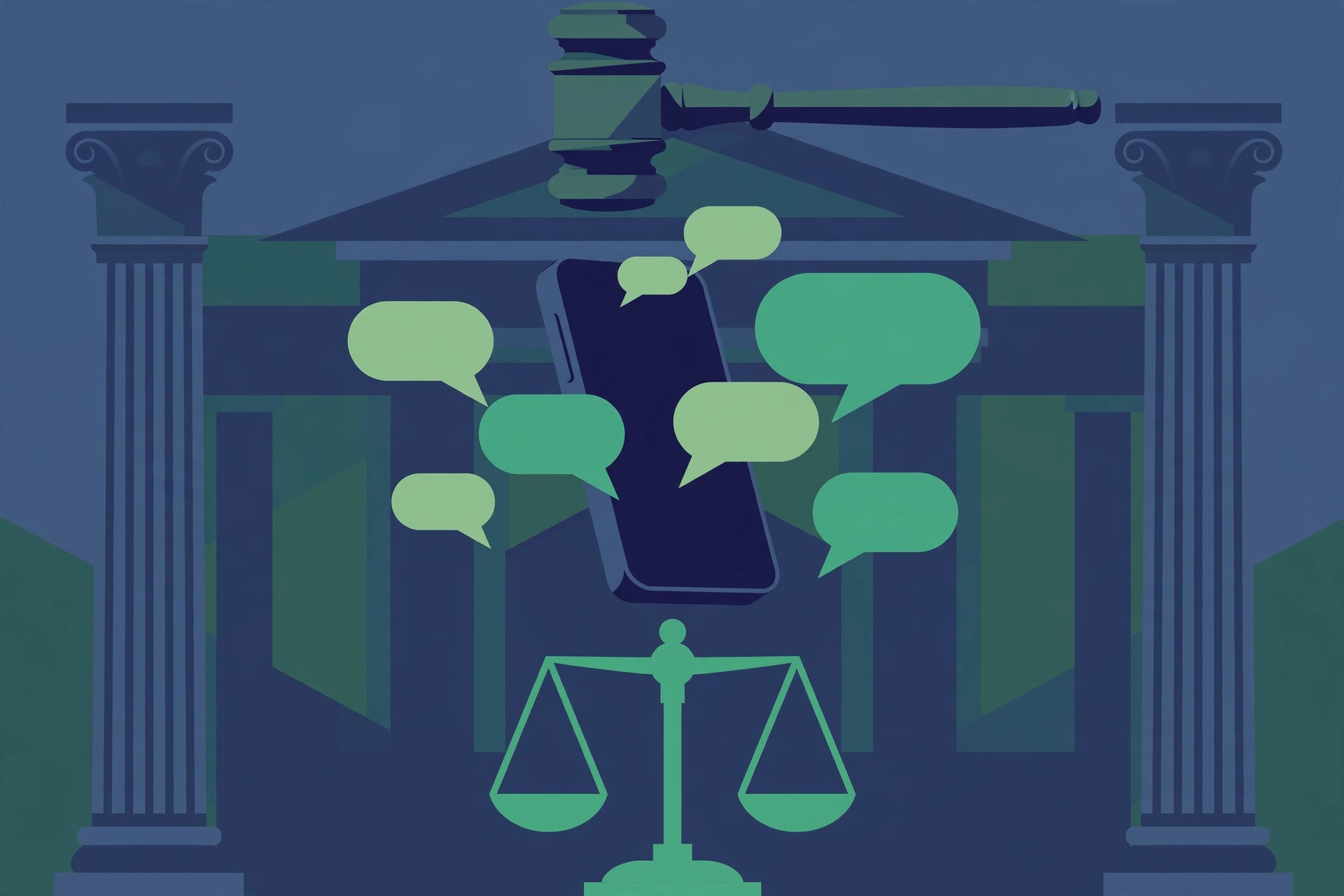
Imagine you are a lawyer. You appear before a civil judge in a case, and the judge passes an order you believe is unfair. You walk out of the courtroom angry. That evening, sitting at home, you open Facebook or X and type out your frustration — except you don't just criticise the order, you attack the judge personally, using insulting and degrading language, and you hit "post." By morning, the post has been shared dozens of times.
What happens next, most people assume, is nothing. Social media is full of angry posts, and the internet forgets quickly. But in one recent case, the consequences were very real: the Peshawar High Court sentenced a lawyer, Asadullah Advocate, to six months in prison and imposed a fine of Rs100,000 for making inappropriate and derogatory comments against a female civil judge posted in Swat on social media. The court found him guilty of contempt of court under Section 3 of the Contempt of Court Ordinance, 2004, and issued a short order, with a detailed judgment to follow.
This article explains, in plain language, what contempt of court means in Pakistan, why personal attacks on judges — especially on social media — are treated so seriously, what extra responsibility lawyers carry, where the line sits between free speech and contempt, and what you should actually do if you are angry about a court's decision.
What Actually Happened: The Case in Brief
Let us stick strictly to what has been reported. A complaint was filed against Asadullah Advocate for using insulting and offensive language against a female civil judge posted in Swat, Khyber Pakhtunkhwa, in posts made on social media. The Peshawar High Court took up the matter as a contempt case. In its short order, the court held that the lawyer had committed contempt of court under Section 3 of the Contempt of Court Ordinance, 2004, and sentenced him to six months' imprisonment along with a fine of Rs100,000. The court stated that a detailed judgment would be released later, which will set out its full reasoning.
That is the factual core. Everything else in this article is the legal background you need to understand why a court would send a lawyer to prison over social media posts — because on the surface, to a non-lawyer, it can look like an overreaction. It is not. It follows from a body of law that is over a century old in its principles and very much alive today.
What Is Contempt of Court? The Basic Idea
Contempt of court is, at its simplest, conduct that disrespects, disobeys, or undermines the authority of a court. The reason the law exists is not to protect judges' feelings or egos. It exists to protect something bigger: the public's confidence that when they walk into a courtroom, they will get a fair hearing from an independent judge, and that the court's orders will actually be obeyed.
Think of it this way. A court has no police force of its own and no army. Its power rests entirely on authority — on the shared understanding in society that court orders must be followed and that judges must be free to decide cases without fear or favour. If anyone could freely threaten judges, bribe witnesses, disobey orders, or run smear campaigns against judges who rule against them, the whole system would collapse. People would stop trusting courts, and disputes would be settled by power and money instead of law. Contempt law is the shield around that authority.
Pakistani law divides contempt into two broad types, and the distinction matters:
Civil contempt is about disobedience. It means wilfully disobeying a court's order, judgment, decree, direction, or undertaking given to the court. Example: a court orders you to hand over possession of a property by a certain date, and you deliberately refuse. The purpose of punishing civil contempt is mainly coercive — to force compliance.
Criminal contempt is about attacks on the administration of justice itself. It covers publishing or doing anything that scandalises the court, prejudices or interferes with judicial proceedings, or obstructs the administration of justice in any other way. Example: running a campaign accusing a judge of taking bribes to influence a pending case, or threatening a witness. The purpose here is punitive — to punish conduct that damages the justice system.
The lawyer's case in Swat falls squarely in the criminal contempt category: derogatory public comments against a judge, made on social media, which the court treated as scandalising the court and undermining judicial authority.
The Legal Framework: Article 204 and the Contempt of Court Ordinance, 2004
Contempt powers in Pakistan come from two main sources.
Article 204 of the Constitution gives the Supreme Court and the High Courts the power to punish any person who commits contempt of court. This is a constitutional power — it sits in the Constitution itself, which tells you how seriously the framers took it. The High Courts are courts of record with inherent authority to protect their own dignity and functioning. A High Court does not need anyone's permission to start contempt proceedings; it can act on its own motion when it comes to know of contemptuous conduct.
The Contempt of Court Ordinance, 2004 is the statute that sets out the detailed law: what counts as contempt, the procedure for contempt proceedings, the defences available, and the punishments. Section 3 of the Ordinance — the provision under which Asadullah Advocate was convicted — deals with criminal contempt, covering acts that scandalise the court or otherwise obstruct the administration of justice.
It is worth noting the history briefly, because it shows this is not some new or unusual law. Pakistan's contempt law has roots in the English common law tradition, and there were earlier statutes — including a 1976 Act and a 2003 Ordinance — before the current 2004 Ordinance. The Supreme Court has also laid down important principles over the decades about how contempt powers should be used: firmly, but with restraint, and never to suppress honest criticism.
"Scandalizing the Court": Why Attacks on Judges Get Special Treatment
The phrase "scandalising the court" sounds old-fashioned, but it describes a very modern problem. It means publishing statements that lower the authority of the court or a judge in the eyes of the public — for example, accusing a judge of corruption, bias, or immorality in a way that is not fair criticism of a judgment but a personal attack on the judge's integrity.
Why does the law treat this so seriously? Because of a simple chain of reasoning that courts have repeated for generations:
- The justice system only works if the public trusts it.
- A judge who is publicly humiliated, threatened, or smeared may — consciously or unconsciously — be influenced in future decisions. Even if the particular judge is thick-skinned, other judges watching may become fearful.
- Litigants who see judges being attacked with no consequences may conclude that judgments are for sale or that courts are just another arena of power politics.
- Once that trust is gone, people stop bringing disputes to court — and start settling them through influence, money, or force.
That is why a personal attack on a judge is not treated like an ordinary insult between two private citizens (which would be a defamation matter). It is treated as an attack on the institution of justice itself. And that is why the punishment can include imprisonment: the law wants the deterrent to be real.
Social media has made this problem sharper. A derogatory post about a judge used to reach a few dozen people at a tea stall; today it can reach hundreds of thousands in hours, be screenshotted and shared permanently, and be amplified by people who never verified a word of it. Courts across Pakistan have recognised that the scale and permanence of online attacks make them more, not less, serious. Posting "in anger" or "in the heat of the moment" is not a defence — the law judges the act and its effect, not the mood you were in when you typed it.
One more point specific to this case: the target was a female civil judge. That does not change the legal category of the offence — contempt law protects all judges equally. But it is worth noting as a matter of basic professional decency that personal attacks on judges, and particularly gendered abuse directed at women in the judiciary, corrode the environment in which justice is done. A judiciary in which judges — especially women judges serving in difficult postings — can be publicly degraded with impunity is a judiciary that will struggle to attract and keep honest officers.
Lawyers Are Officers of the Court: A Higher Standard
Here is the part of the story that explains why the sentence was severe. Asadullah was not an ordinary citizen venting on Facebook — he was an advocate, a member of the legal profession. In the eyes of the law, a lawyer is an "officer of the court." That phrase carries a specific meaning: lawyers are not just service providers to their clients; they are participants in the administration of justice, with duties to the court that override even their duty to the client when the two conflict.
This higher standard shows up in several ways:
Lawyers know the system from the inside. An ordinary litigant who rants online might genuinely not know the difference between appealing a judgment and attacking a judge. A lawyer knows — or is professionally required to know — that the remedy for a wrong order is an appeal, a revision, or a review, not a social media campaign. When a lawyer chooses the megaphone over the appeal, the court reads it as a deliberate choice.
Lawyers' words carry extra weight. When an advocate publicly accuses a judge of misconduct, the public listens differently than when a random account does it. The statement borrows credibility from the speaker's professional status. That makes the damage to public confidence greater — and the contempt more serious.
The profession's dignity is at stake. Bar councils and courts have long held that a lawyer who scandalises the judiciary damages not only the court but the legal profession itself. The public cannot be expected to respect lawyers who show contempt for the very courts they practise in.
This does not mean lawyers cannot criticise judgments. They can — and the best legal commentary in Pakistan does exactly that, rigorously and publicly. What they cannot do is cross from criticism of a decision into personal abuse of the decision-maker, especially in language designed to humiliate rather than to argue.
What the Bar Councils Can Do: Professional Misconduct
A contempt conviction is not the only consequence a lawyer faces. Pakistan's legal profession is regulated under the Legal Practitioners and Bar Councils Act, 1973, and the provincial bar councils (along with the Pakistan Bar Council) have disciplinary powers over advocates. Conduct that brings the profession into disrepute — and a contempt conviction for abusing a judge certainly qualifies — can trigger disciplinary proceedings for professional misconduct.
The possible outcomes of bar council disciplinary proceedings are serious and go beyond anything a court imposes in the contempt case itself:
- Reprimand or warning for less serious misconduct.
- Suspension of the licence to practise for a fixed period — meaning the lawyer cannot appear in any court or take clients during the suspension.
- Removal from the roll of advocates — striking off, which ends the lawyer's career in the profession.
These proceedings are separate from the contempt case. In other words, the six months' imprisonment and the Rs100,000 fine may not be the end of the matter for the convicted lawyer; the bar council can independently examine whether his conduct amounts to professional misconduct and act accordingly. For any practising lawyer reading this, that is the part worth dwelling on: a few minutes of angry typing can cost you your livelihood.
Free Speech vs Contempt: Where Exactly Is the Line?
This is the question everyone asks, and it deserves a careful, honest answer — because Pakistan's Constitution also guarantees freedom of speech under Article 19, and the tension between free expression and contempt law is real.
The line the law draws is between criticising a judgment and attacking the judge. Here is how to tell them apart:
Fair criticism (protected): "The trial court's order in this case is wrong because it misreads Section X and ignores the Supreme Court's ruling in Y case. Here is why the reasoning fails..." This is about the decision, its reasoning, and the law. It is temperate in language, it engages with the substance, and its purpose is to improve the administration of justice through debate. The Contempt of Court Ordinance recognises defences for fair comment and fair criticism of judicial proceedings — the law does not demand silence about bad judgments.
Contempt (punishable): "This judge is corrupt / biased / sold out / morally filthy, and that is why she decided against me." This is about the person, not the reasoning. It offers no legal argument, it uses degrading language, and its purpose is to humiliate and to destroy public trust in the judge. Accusations of corruption or bias made without proof, personal abuse, threats, and campaigns to pressure a judge in a pending case all fall on this side of the line.
A few practical tests you can apply to your own words before posting:
- Am I talking about the order or the person? If your post is full of adjectives about the judge and empty of arguments about the law, you are on dangerous ground.
- Would I say this in a courtroom, on the record? If not — if you would never dare say it to the judge's face in open court — that tells you something about whether it is fair criticism or abuse.
- Is the case still pending? Commenting on a pending case in a way that pressures the judge or prejudices the proceedings is treated even more seriously than commenting after final disposal.
- Am I stating facts I can prove? An unproven allegation of corruption against a judge is not "free speech" in any legal system — it is defamation at minimum, and contempt when it targets the judiciary.
The honest summary: you have every right to say a judgment is wrong, to write a detailed critique of it, to discuss it publicly, and to get it reversed on appeal. You do not have a right to degrade the judge who wrote it.
The Penalties: What Contempt Can Cost You
Under the Contempt of Court Ordinance, 2004, a person found guilty of contempt can face:
- Imprisonment — the Ordinance provides for imprisonment, and as this case shows, courts do impose actual jail time, not just symbolic sentences. Six months in prison is a severe, life-altering punishment.
- Fine — Rs100,000 in this case, and fines can be substantial.
- Both — imprisonment and fine together, as happened here.
Beyond the statute, a contempt conviction carries consequences the order itself does not spell out: a criminal record, damage to professional reputation (career-ending for a lawyer, as discussed above), and — for an ordinary citizen — the possibility of related proceedings. In some contexts, contempt findings can also affect a person's eligibility for public office or professional licences, depending on the applicable laws.
There is also a procedural point worth knowing: in contempt proceedings, the usual protections work differently than in an ordinary criminal trial. The court itself is the complainant, prosecutor, and judge — which is why appellate courts insist that contempt powers be exercised with great care and restraint. The convicted person does, however, have the right to appeal the contempt order to a higher forum, and courts have set aside or reduced contempt convictions on appeal where the proceedings were flawed or the punishment excessive. An apology, if genuine, unconditional, and offered at the earliest opportunity, has also traditionally been a mitigating factor — though it is entirely at the court's discretion whether to accept it, and a calculated or half-hearted apology rarely helps.
Lost Your Case? Do This Instead of Posting Online
If you are a litigant who believes a judge got it wrong, your anger is understandable — but social media is the one place it will hurt you instead of helping you. Here is what the law actually offers you, step by step:
1. Appeal. Almost every adverse order can be challenged before a higher court: a civil judge's decree goes to the district/appellate court, and from there to the High Court; High Court orders in many matters can go to the Supreme Court. An appeal is the proper, powerful way to say "this decision is wrong" — and appellate courts reverse trial courts every single day. That is the system working as designed.
2. Revision and review. Where an appeal does not lie, the law often provides revision (asking a higher court to examine the legality of an order) or review (asking the same court to reconsider on specific grounds such as an error apparent on the face of the record). Your lawyer will know which remedy fits your order.
3. Complaint through proper channels. If your grievance is about a judge's conduct rather than the merits of the decision — for example, genuine misbehaviour — there are institutional channels: the district judiciary's inspection and vigilance mechanisms, and ultimately the Supreme Judicial Council for judges of the superior judiciary. A documented complaint through proper channels is infinitely more powerful, and infinitely safer, than an online rant.
4. Write a reasoned critique. Nothing stops you — or your lawyer — from publishing a calm, argued analysis of why the judgment is legally wrong. Legal commentators do this constantly. Keep it about the reasoning, keep the language professional, and you are exercising free speech, not committing contempt.
5. Never post in anger. If you must write about your case online, write the draft, sleep on it, and show it to your lawyer before posting. Ask one question: "Could any sentence in this be read as a personal attack on the judge?" If yes, delete it. The few minutes of satisfaction from an angry post are not worth a contempt notice.
One final practical warning for litigants: anything you post online about a pending case can also be used against you in that case. Opposing counsel can produce your posts to argue you are trying to influence the proceedings, and judges do take notice of attempted pressure. Silence while the case is pending is not weakness — it is strategy.
Frequently Asked Questions
Q: Can I be jailed just for criticising a court on Facebook? A: Not for fair criticism of a judgment — that is protected speech. You can be punished when your words cross into criminal contempt: personal abuse of a judge, unproven allegations of corruption or bias, or attempts to pressure or prejudice proceedings. The dividing line is between attacking the decision (allowed) and attacking the judge (punishable). In the Swat case, the court found the lawyer's posts to be derogatory personal comments against the judge, which is why it imposed imprisonment under Section 3 of the Contempt of Court Ordinance, 2004.
Q: What is the difference between civil and criminal contempt? A: Civil contempt is wilful disobedience of a court's order, judgment, or direction — for example, refusing to comply with a decree. Its purpose is mainly to compel compliance. Criminal contempt covers acts that scandalise the court, prejudice or interfere with judicial proceedings, or otherwise obstruct the administration of justice — for example, publishing abusive material about a judge. Social media attacks on judges fall under criminal contempt.
Q: Does contempt law violate freedom of speech under Article 19 of the Constitution? A: Article 19 guarantees freedom of speech, but it is expressly subject to "reasonable restrictions" imposed by law, including in relation to contempt of court. The courts have consistently held that fair and temperate criticism of judgments is protected, while personal attacks that undermine the administration of justice are not. In other words, the Constitution protects your right to say a judgment is wrong; it does not protect a right to degrade the judge.
Q: I am a lawyer. Can I comment publicly on a judgment I appeared in? A: Yes — lawyers comment on judgments all the time, and rigorous public legal analysis is valuable. But as an officer of the court you are held to a higher standard: keep your commentary focused on the decision's reasoning, use professional language, and never make personal allegations against the judge. Remember that a contempt conviction can also trigger bar council disciplinary proceedings, putting your licence to practise at risk.
Q: If I already posted something abusive about a judge, what should I do? A: Delete the post immediately — though understand that screenshots may already exist, so deletion limits future damage rather than erasing the act. Do not post follow-ups, explanations, or justifications that repeat the allegations. Consult a lawyer at once, before any notice arrives. If contempt proceedings begin, an early, genuine, and unconditional apology has traditionally been treated as a mitigating factor, though whether to accept it is entirely the court's discretion. Do not try to handle a contempt notice on your own.
Q: Can a contempt order be appealed? A: Yes. A person convicted of contempt has the right to challenge the order before a higher forum, and appellate courts do examine contempt convictions carefully — because the same court acts as complainant and judge, higher courts insist the power must have been exercised fairly and with restraint. An appeal can result in the conviction being set aside or the sentence reduced if the proceedings were flawed or the punishment disproportionate.
Q: What should I do if I genuinely believe a judge is corrupt? A: Do not post the allegation on social media — an unproven public accusation against a judge is itself contempt, and possibly defamation, regardless of what you believe. Use institutional channels: for subordinate judiciary, the High Court's inspection and vigilance system; for High Court and Supreme Court judges, the Supreme Judicial Council under Article 209 of the Constitution. Put your complaint in writing, with whatever evidence you have, through the proper channel. That is slower and less satisfying than a viral post — but it is the only route that can actually lead to accountability without landing you in prison.
The Bottom Line
This article provides general legal information for readers in Pakistan and is not legal advice. For advice about your own situation, consult a qualified advocate.