
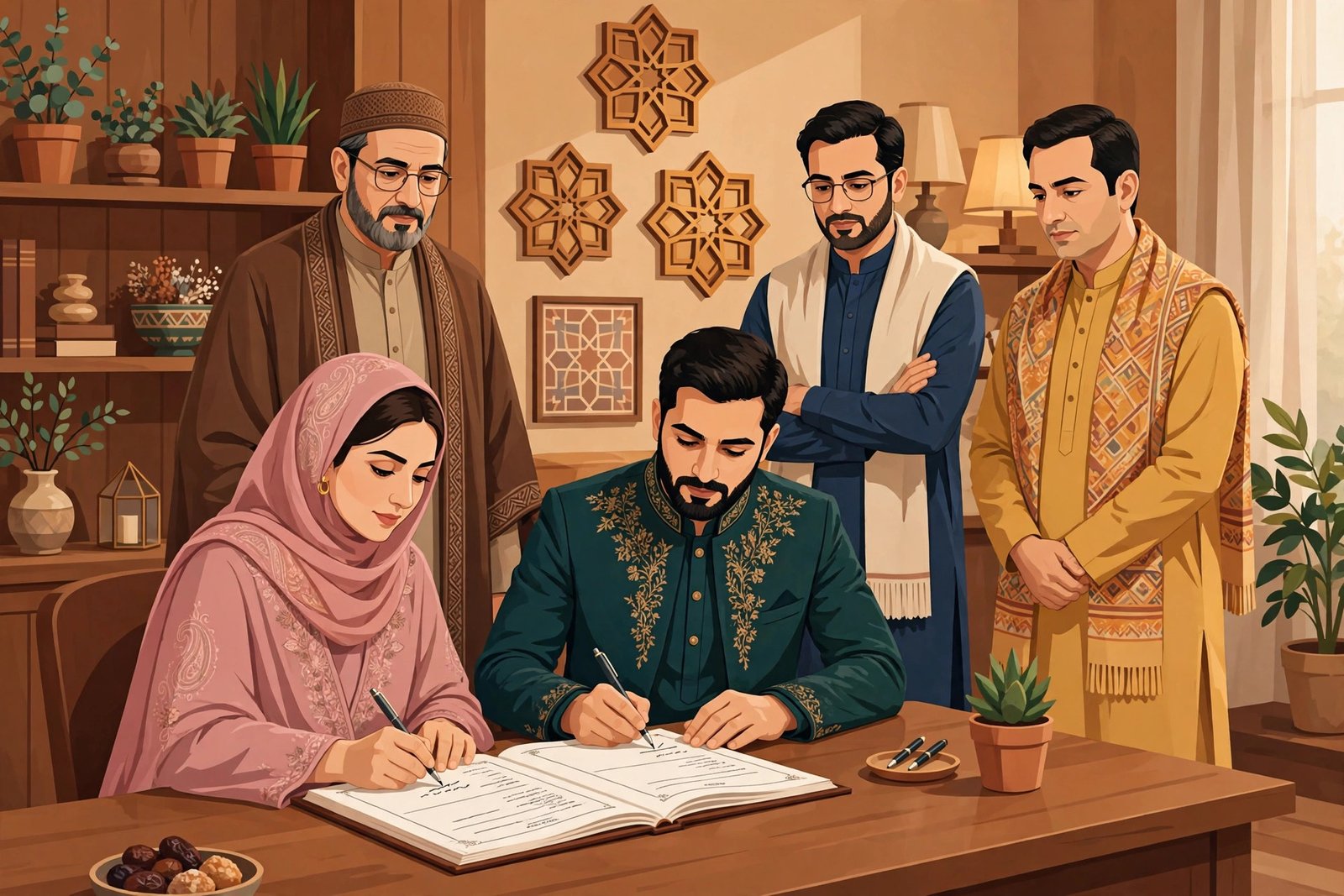
Nikah Nama Registration in Pakistan: Union Council, NADRA & What to Check Before Signing
Registering your nikah nama in Pakistan properly is one of the most important legal steps after a nikah ceremony. Your Nikah Nama is a binding legal contract that protects your marriage, your haq mehr, and your rights in divorce, khula, visa applications, and inheritance disputes.
Quick answer: Every Muslim marriage in Pakistan must be registered under Section 5 of the Muslim Family Laws Ordinance 1961. The licensed nikah khawan fills in the Urdu Nikah Nama and registers it with the Union Council; afterwards you can get the NADRA computerized marriage certificate — the bilingual document needed for visas, CNIC updates, and legal proceedings.
Is Nikah Nama Registration Compulsory in Pakistan?
Yes. Section 5 of the Muslim Family Laws Ordinance, 1961 says plainly: "Every marriage solemnized under Muslim Law shall be registered in accordance with the provisions of this Ordinance."
How it works in practice:
- The Union Council licenses Nikah Registrars (one per Ward) — these are the authorized nikah khawans.
- If the nikah is solemnized by someone else, that person must report it to the registrar for registration.
- Failing to report or register is punishable: up to 3 months' imprisonment or a fine up to Rs. 1,000 or both under Section 5(4). In Punjab, penalties for a negligent registrar can reach Rs. 100,000 under the provincial rules.
Religiously, a nikah with ijab-o-qubool is valid without registration. But legally, without registration there is no computerized marriage certificate — and embassies, NADRA, and courts will not treat your marriage as officially recorded.
What Is the Role of the Nikah Khawan in Registration?
The nikah khawan is your licensed Nikah Registrar, appointed by the Union Council. He fills in the official Nikah Nama form (in quadruplicate) at the ceremony, collects signatures or thumb impressions of the couple and two witnesses, and submits it to the Union Council.
This is mainly the nikah khawan's legal duty — but wise families always follow up. A Punjab diagnostic study found hundreds of nikah namas unregistered years after the ceremony. Never assume the maulvi handled it — verify it yourself.
What Documents Are Required for Nikah Nama Registration?
To get the computerized certificate from the Union Council (or TMA / Cantonment Board / Arbitration Council in Islamabad), keep these ready:
- Original Urdu Nikah Nama, duly filled and signed, plus photocopies
- CNICs of the bride and groom (originals + copies)
- CNICs of both fathers (bride's and groom's fathers)
- CNIC of the nikah khawan
- Passport copies if either spouse is a foreign national
- Divorce or death certificate (original) if either party was previously married
How Do You Get the NADRA Computerized Marriage Certificate?
NADRA itself does not issue the marriage certificate. The computerized certificate (Marriage Registration Certificate) is issued by the local authority — Union Council, TMA Office, Cantonment Board, or the Arbitration Council in Islamabad — on the NADRA-linked system, in Urdu and English. Submit the original Urdu Nikah Nama with your documents for verification and issuance.
Fees vary by district — typically a few thousand rupees, more for urgent service, plus a late-registration charge for old marriages. Embassies accept this computerized certificate for spouse visas, NADRA requires it to update the wife's marital status, and family courts ask for it in khula and divorce cases.
Can You Register a Nikah Late?
Yes. Even old marriages can be registered if you produce the original manual Nikah Nama. Expect a late-registration penalty (usually a few thousand rupees, varying by district) plus extra verification.
What Should You Check Before Signing the Nikah Nama?
Almost nobody reads this document before signing. Check these clauses first:
Clause 13–17: Haq Mehr (dower)
These columns record the haq mehr the husband owes the wife. Confirm the amount is written in figures and words, and whether each portion is Haq-e-Muajjal (prompt — payable immediately) or Haq-e-Muwajjal (deferred). Never leave it vague — vague entries cost the wife her right in court.
Clause 18: Delegation of the Right of Divorce (Talaq-e-Tafweez)
The most important column for the bride. It asks whether the husband delegates the power of divorce to the wife. If delegated, she can dissolve the marriage herself without a lengthy khula suit — keeping her haq mehr — while the husband's own right of divorce stays intact.
Nikah khawans often cross this column out without asking the bride. Under the 2015 Punjab amendment, it must be answered with a clear yes or no — crossing it out invites legal liability. Insist on an answer.
Clauses 17 and 19: Special and Other Conditions
Clause 19 records any agreed conditions attached to the husband's right of divorce, while Clause 17 covers special conditions — for example, about residence, maintenance, or education. Finalize these with the families before the ceremony, and ask to see the Nikah Nama the day before the wedding.
What Happens If the Nikah Is Not Registered?
- No computerized marriage certificate — blocking spouse visas, the wife's CNIC update, and family court proceedings.
- The nikah khawan or registrar faces penalties under Section 5 of the Muslim Family Laws Ordinance 1961.
- The marriage is not automatically void under Muslim law, but proving it later — for inheritance, maintenance, or khula — becomes much harder without an official record.
- Always confirm the Union Council entered your nikah and use a licensed nikah khawan; the Urdu Nikah Nama alone is not enough for visas or courts.