
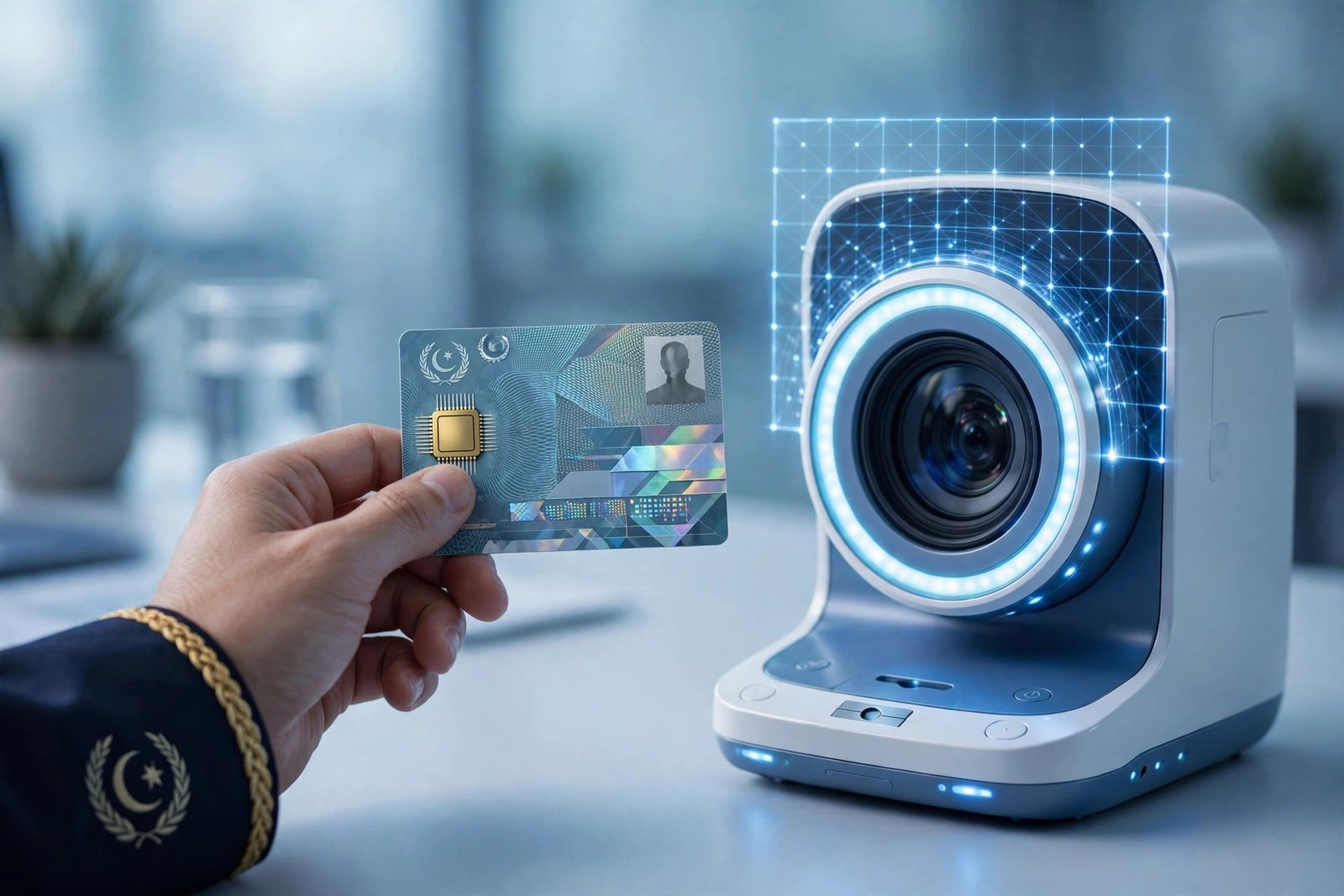
Quick answer: Pakistan has notified the National Identity Card Rules, 2026 through S.R.O. 330(I)/2026, which expands the legal definition of "biometrics" beyond fingerprints to include iris scans and facial recognition. NADRA now issues facial-recognition-based verification certificates at registration centres for citizens whose fingerprints are faded or unreadable, and these certificates work for bank transactions, SIM verification, and other biometric checks.
Why did the government have to change the NIC Rules at all?
For twenty years, Pakistan's identity system had one golden rule: no fingerprint match, no service. Your thumbprint was the key to everything — opening a bank account, withdrawing cash from a branch, getting a new SIM, applying for a succession certificate, even collecting your pension.
But fingerprints are fragile things. They fade.
I saw this firsthand at a District Courts Islamabad case a few years ago — not a fingerprint case at all, but the point stuck with me. An elderly litigant needed to verify a court document, and the bank had already sent him back twice because their machine couldn't read his thumbs. He wasn't a fraudster. He was a retired schoolteacher in his seventies who had spent forty years writing on a blackboard with chalk. Chalk dust, decade after decade, had worn his fingerprints smooth.
Under the old rules, he was stuck in a loop. The law said: biometrics means fingerprints. The machine said: no match found. And nobody in the system had the legal authority to say, "Fine, let's verify your face instead."
S.R.O. 330(I)/2026 closes that loop. The 2026 amendment to the National Identity Card Rules rewrites the definition of "biometrics" so that it now covers iris scans and facial recognition alongside traditional fingerprints. That one definitional change — a few lines of legal text — is what gives every NADRA officer, bank branch, and telecom franchise a legal basis to accept your face or your eyes as proof that you are who you say you are.
What exactly do the National Identity Card Rules, 2026 say?
Let's be precise, because this is where most social-media summaries go wrong.
The Government of Pakistan has notified amendments to the National Identity Card Rules, 2026, vide S.R.O. 330(I)/2026. The headline change is definitional: "biometrics" no longer means only fingerprints. The term now legally includes:
- Fingerprints — the traditional ten-finger biometric, unchanged.
- Iris scans — the pattern of your iris, captured with a scanner at the registration centre.
- Facial recognition — a facial scan matched against the photograph and biometric record NADRA holds for you.
Three things flow from this.
First, NADRA can now capture and store iris and facial biometrics as part of the national identity database, with the same legal standing as fingerprints. Before this, any face scan was just a photograph. Now it's a legally recognised biometric — evidence-grade, admissible, official.
Second, NADRA's registration centres can issue facial-recognition-based verification certificates to citizens whose fingerprints are faded, damaged, or unreadable. This is the single most practical part of the whole amendment. You walk in, your face is scanned and matched, and you walk out with a certificate that banks, telecom companies, and government offices must treat as valid identity verification.
Third, QR-based verification has been integrated into the identity framework. Identity documents and verification outputs can now carry QR codes that link to NADRA's verification record, so a counter clerk — or an app — can confirm your identity faster without needing a full biometric terminal. Think of it as the bridge between the physical card and the digital record.
(If the details of your card itself are wrong — wrong name spelling, wrong father's name, wrong date of birth — that's a separate process, covered in our guide on how to correct errors on your CNIC at NADRA.)
Who actually benefits from face and iris verification?
Not everyone. Let's be honest — if your fingerprints read fine, nothing changes for you. Your thumbprint still works everywhere it worked last year. The 2026 rules don't replace fingerprints; they add alternatives for people the old system quietly excluded.
Elderly citizens. This is the biggest group. Skin thins with age. Fingerprint ridges flatten. I have seen clients in their late sixties and seventies fail biometric verification at banks three, four times in a row. One retired government servant from Lahore told me he had to bring his son to the bank every month because the branch wouldn't release his pension without a fingerprint match, and his wouldn't match. Under the new rules, a facial-recognition certificate solves this in one visit.
Manual workers. Construction workers, farmers, factory workers, mechanics, domestic workers who wash dishes all day — anyone whose hands take daily abuse. Consider Muhammad Ramzan, a hypothetical but utterly typical case: a 58-year-old farmer from Multan whose hands are calloused from forty years of harvesting wheat. His CNIC photograph is fine. His thumbprints are basically gone. For years he paid his electricity bill through his nephew because the franchise shop's machine rejected him. A facial verification certificate ends that dependency.
People with medical conditions. Eczema, psoriasis, vitiligo on the hands, burn injuries, amputations, chemotherapy patients whose skin changes — the old rules had no dignified answer for any of them. NADRA's facial-recognition certificate is now that answer.
Women whose fingerprints were never captured properly. Mere tajurbe me aksar ye hota hai: older women, especially from rural areas, who got their first CNIC decades ago when capture equipment and training were poor. Their records are thin. When they need a succession certificate or a bank transaction today, the mismatch creates weeks of delay. Face verification against the stored photograph can cut through that.
So — who doesn't benefit? Anyone hoping this lets them avoid verification. It doesn't. Face and iris scans are more identifying, not less. This is an inclusion reform, not a loophole.
How do you get a facial-recognition verification certificate from NADRA?
Here's the practical part. The process is deliberately simple, because the whole point is to help people who were failing the old process.
Step 1 — Go to a NADRA Registration Centre (NRC). Not a franchise, not an e-Sahulat shop for this first step — the certificate is issued at NADRA's own registration centres. You can locate your nearest one on NADRA's website or by calling the helpline at 1777. Walk-ins are accepted; appointments through the Pak-ID app are faster in big cities like Karachi and Lahore, where queues at the NRC can easily run two to three hours.
Step 2 — Attempt fingerprint verification. Yes, you still try the fingerprints first. The officer records the failed or partial match attempts — usually three attempts on the scanner. This isn't bureaucracy for its own sake; the failed attempts create the record that justifies issuing the facial certificate. Don't skip this step by demanding the face option immediately. Officers follow the sequence, and arguing with them slows everyone down.
Step 3 — Facial scan and verification. The officer captures your face using the centre's camera equipment and matches it against NADRA's stored biometric record for your CNIC. The system checks the live image against the photograph and biometric template already on file. This takes a few minutes.
Step 4 — Certificate issued. Once the match confirms, NADRA issues a facial-recognition-based verification certificate in your name, against your CNIC number. Keep this safe. Photograph it with your phone the same day. If you lose the paper, re-issuance is possible but means another visit and another fee.
Step 5 — Use it at the bank, the franchise, the office. Present the certificate alongside your CNIC wherever biometric verification is required. Banks and telecom companies receive NADRA's verification circulars, so branch staff have been instructed to accept these certificates. That said — and this is practitioner honesty, not optimism — frontline staff at smaller branches sometimes haven't heard of a new circular yet. If a bank clerk refuses your certificate, ask them to check with their branch manager or the bank's compliance desk. The certificate is backed by federal rules; a clerk's unfamiliarity doesn't invalidate it.
Fees and timelines — the honest numbers
NADRA's fee schedule changes, so treat these as the realistic current range rather than gospel carved in stone: a standard CNIC renewal costs around Rs. 750 (normal), Rs. 1,500 (urgent), and Rs. 2,500 (executive) — and facial-verification services are priced in a similar band, typically in the hundreds of rupees, not thousands. Call 1777 or check the Pak-ID app before you go if the exact fee matters to you.
Timeline? The certificate is usually issued the same day at the centre, once verification succeeds. The queue is the real variable. In Islamabad or Lahore on a Monday morning, budget half a day. In a smaller city — say, Sukkur or Abbottabad — midweek, you might be in and out in ninety minutes. NADRA's token system means you wait your turn; there's no "express lane" you can buy at the counter, whatever anyone outside the building offers you. (Ignore touts. Seriously. Every NRC has them, and every one of them is selling something you can do yourself for the official fee.)
What is the QR-based verification, and where will you see it?
The quietest part of the 2026 rules may turn out to be the most visible in daily life. QR-based verification is now part of the identity framework.
What this means in practice: verification documents issued by NADRA can carry a QR code linked to your verification record. A bank officer, a government clerk, or even a smartphone app can scan the code and pull up the verified record — confirming the document is genuine and matches NADRA's database — without a biometric scanner, a fingerprint terminal, or a phone call to a helpline.
Why does this matter? Two reasons.
First, speed. Full biometric verification takes equipment, connectivity, and time. A QR scan takes seconds. For high-volume counters — bank branches on salary day, telecom franchises during a SIM-sale campaign, government offices processing applications — this is a genuine operational improvement.
Second, fraud resistance. A QR code tied to NADRA's live record is far harder to fake than a photocopied certificate. Anyone can print a fake "verification certificate" on a home printer. They cannot fake a QR code that resolves to NADRA's database entry for your CNIC — the scan either matches or it doesn't. So if someone asks you, "Isn't a paper certificate easy to forge?" — the QR integration is the answer.
One caution, though. A QR code is only as trustworthy as the thing scanning it. Always verify through NADRA's own channels — the Pak-ID app or NADRA's official verification services — not through some random "CNIC checker" app from the Play Store. Those third-party apps are exactly how identity data leaks. More on data safety below.
Does this change how you apply for a new CNIC or NICOP?
Short answer: mostly no, with one meaningful upgrade.
New CNIC applications still require the standard process — application form, photographs, fingerprints at the NRC, fee, and the usual processing time (roughly 30 days normal, about a week urgent, a few days executive, though these timelines slip during high-volume periods). The 2026 rules don't remove any of that.
What they do change is what happens when capture fails. Under the old framework, if your fingerprints couldn't be captured properly at application time, your file went into a special-handling pile and you waited — sometimes for months — while exceptions were processed manually. Now, the officer has a legal alternative: capture the iris scan or facial biometric and proceed. Your application moves forward instead of stalling.
For overseas Pakistanis applying for NICOP, the same logic applies at NADRA centres and embassies: where fingerprint capture is a problem, the new biometric options keep the file moving. The rules don't change NICOP fees or the documents you need — just the fallback when biology doesn't cooperate with the scanner.
Documents checklist — what to carry to the NRC
Don't make two trips. NADRA centres are not places you want to visit twice.
- Your original CNIC (even if expired — bring it; the number is what matters).
- A photocopy of your CNIC, front and back. The centre has copiers, but the queue for them is its own special circle of waiting.
- Proof of the failed verification, if you have it. A bank's rejection slip, a screenshot of the failed biometric attempt, a letter from the branch — anything that documents that your fingerprints aren't reading. Not strictly required, but it makes the officer's job easier and your visit shorter.
- Any medical evidence, if applicable. A doctor's note or prescription mentioning the skin condition, burn, or treatment affecting your fingerprints. Again, not mandatory — but in borderline cases it helps.
- The fee in cash or via the centre's payment options. NRCs accept the standard NADRA fee payment modes; confirm at the token counter.
- Yourself, obviously — and looking like your CNIC photograph. This sounds like a joke. It isn't. The facial match compares your live face to the photograph NADRA has on file. If your CNIC photo is fifteen years old and you've since grown a full beard, lost significant weight, or changed your appearance dramatically, the match can struggle. If that's your situation, consider applying for a photograph update on your CNIC at the same visit — it costs a renewal fee, but it makes every future verification smoother. (For wrong details on the card itself, see our guide on CNIC correction at NADRA.)
Women in niqab or hijab: NADRA centres have female staff and private booths for facial capture where required. Ask at the token counter — this is routine for them.
Common mistakes people make with the new biometric rules
Mistake 1: Assuming the face certificate replaces your CNIC. It doesn't. The certificate is a verification document, not an identity document. You still need your CNIC for everything. The certificate just proves, to a bank or franchise, that the person holding the CNIC is its rightful owner when fingerprints can't do the job. Carry both.
Mistake 2: Going to an e-Sahulat franchise expecting the certificate. The facial-recognition certificate is issued at NADRA Registration Centres. Franchises and e-Sahulat outlets can use the certificate for verification once you have it, but they don't issue it. Going to the wrong place first is the most common wasted trip I hear about.
Mistake 3: Demanding face verification without attempting fingerprints. The process is sequential — fingerprints first, face as the fallback. Officers are following their SOP. If you refuse the fingerprint attempt, you're not fast-tracking anything; you're creating a standoff with the one person who can help you.
Mistake 4: Paying a tout outside the centre. Every NRC has men outside offering to "get your work done fast" for Rs. 2,000–5,000. They cannot issue anything. They cannot skip the queue legally. At best they fill your form; at worst they vanish with your money and a photocopy of your CNIC — which is an identity-theft starter kit. The official fee is a few hundred rupees. Pay that, at the counter, and get a receipt.
Mistake 5: Using unofficial "NADRA verification" apps. The Play Store is full of apps claiming to verify CNICs, check SIM ownership, or "download anyone's data." Many are data-harvesting operations. Some are outright scams. NADRA's official channels are the Pak-ID app, the 1777 helpline, and the NADRA website. Everything else is suspect until proven otherwise — and "proven otherwise" almost never happens.
Mistake 6: Thinking this is optional for banks. It's not. Once NADRA issues you a facial-recognition certificate under the 2026 rules, banks and telecom operators are required to honour it for biometric verification purposes. If a branch refuses, escalate: branch manager first, then the bank's complaint cell, then the Banking Mohtasib if needed. The rules are federal law, not a NADRA suggestion. That said, give frontline staff a little grace in the first months — circulars take time to reach every branch in the country, and a calm explanation works better than a shouting match.
Mistake 7: Ignoring the photograph mismatch. As noted above — if you look nothing like your CNIC photo anymore, the facial match may fail or need manual review, which adds time. Updating your photograph is cheap compared to a second wasted visit.
Your biometric data and the law — is your face safe with NADRA?
Fair question. You're handing the state a scan of your face and your irises. What stops misuse?
Three layers, in plain language.
Layer one: the data stays with NADRA. The 2026 rules expand what NADRA may capture and recognise as biometrics. They don't create a free-for-all where banks keep copies of your face scan. Verification works on a match/no-match basis — the bank sends the live scan, NADRA's system says "matches CNIC number X" or "doesn't match." The bank doesn't get to keep your biometric template. That's how the architecture is designed, and it's the same principle that already applied to fingerprints.
Layer two: PECA and privacy law. Pakistan's Prevention of Electronic Crimes Act, 2016 criminalises unauthorised access to and misuse of data, and NADRA's own governing law — the NADRA Ordinance, 2000 — restricts disclosure of database information with criminal penalties for officials who leak it. An officer who sells or leaks your biometric data isn't committing a minor infraction; they're committing an offence.
Layer three: your own vigilance. The weakest link in any identity system is the citizen who photographs their CNIC — front and back — and sends it on WhatsApp to a stranger offering a "loan" or a "job." No rule, however well drafted, protects you from that. Keep your CNIC images off social media, don't share them in groups, and treat anyone asking for them with the suspicion they deserve.
A rhetorical question worth sitting with: is a face scan more sensitive than a fingerprint? In one sense, yes — you leave your face everywhere, on every CCTV camera, in every photograph. But that's exactly why facial recognition as a verification tool is designed around liveness and matching against a secured template, not around the photograph itself. The security doesn't come from your face being secret. It comes from the match being hard to fake.
What if NADRA's system wrongly rejects your face?
It happens. Technology fails, lighting is bad, the database photograph is ancient, the operator rushes the capture. If your facial verification fails at the centre:
- Ask for a re-capture. Different lighting, straight-on angle, neutral expression. Most failures are capture quality, not identity problems.
- Ask for manual/supervisor review. NRCs have supervisors who can review edge cases and approve manual verification against your file.
- Update your photograph if the mismatch is because you've changed.
- File a written complaint through NADRA's complaint system (1777, the website, or the Pak Citizen Portal) if you're being turned away without proper process. Keep the complaint number.
- As a last resort, the courts. A citizen wrongly denied identity verification — and thereby denied banking, SIM, or pension access — can approach the High Court through a writ petition. Courts take a dim view of the state denying citizens their own identity. I've never seen it go that far for a straightforward verification case, but the remedy exists, and NADRA knows it exists.
Frequently asked questions
What is S.R.O. 330(I)/2026? It's the statutory regulatory order through which the Government of Pakistan notified the amended National Identity Card Rules, 2026. Its key change is expanding the legal definition of "biometrics" to include iris scans and facial recognition alongside fingerprints, and enabling NADRA to issue facial-recognition-based verification certificates.
My fingerprints work fine. Does anything change for me? No. If your fingerprints verify normally, keep using them — nothing in the 2026 rules forces you to switch to face or iris verification. The new options are fallbacks for people whose fingerprints are faded, damaged, or unreadable, not replacements for everyone.
Where can I use the facial-recognition certificate? Anywhere biometric verification is required: bank branches for account opening and transactions, telecom franchises for SIM issuance and biometric re-verification, government offices, and NADRA's own services such as succession certificates. It's issued against your CNIC number and carries QR-based verification.
How much does the facial verification certificate cost? NADRA prices it in the same band as its other verification services — typically a few hundred rupees, comparable to standard CNIC service fees (roughly Rs. 750 normal / Rs. 1,500 urgent / Rs. 2,500 executive for CNIC services). Confirm the exact current fee on the Pak-ID app or by calling 1777 before visiting.
How long does it take to get the certificate? Usually the same day. The verification and issuance itself takes under an hour once you're at the counter. The real variable is the queue — budget half a day at busy urban centres on Mondays, or as little as ninety minutes at smaller centres midweek.
Can I get facial verification through the Pak-ID app at home? The Pak-ID app handles many NADRA services, but the facial-recognition certificate for failed fingerprints is issued at physical registration centres, where trained staff capture the scan under controlled conditions. Check the app first — NADRA keeps expanding its digital services — but plan on one in-person visit.
Will banks really accept it, or will the clerk just stare at me? They're required to. The certificate is issued under federal rules, and NADRA circulates verification instructions to banks and telecom operators. In the early months, carry patience along with the certificate: if a clerk hasn't seen one before, ask for the branch manager. Escalation — bank complaint cell, then Banking Mohtasib — exists if a branch flatly refuses.
Does the QR code on the certificate mean anyone can scan my data? No. The QR links to NADRA's verification record and confirms the certificate's genuineness when scanned through proper channels. It doesn't hand your personal details to whoever points a phone at it. Still, don't post photos of the certificate online — treat it like your CNIC.
What if my appearance has changed a lot since my CNIC photo? Then get your photograph updated. The facial match compares your live face against NADRA's stored record; a fifteen-year-old photo versus a very different face today can cause failures or long manual reviews. A photo update at the NRC costs a standard renewal fee and saves you repeated hassle.
I'm an overseas Pakistani. Does this help with NICOP? Yes, in the same way: where fingerprint capture fails at a NADRA centre or embassy during a NICOP application, officers can now use iris or facial biometrics as the legal fallback instead of stalling your file. The documents, fees, and process for NICOP itself are unchanged.
The bottom line
S.R.O. 330(I)/2026 is one of those legal changes that sounds technical and turns out to be deeply human. A definition — three words added to what "biometrics" means — and suddenly the retired teacher in Rawalpindi whose chalk-worn thumbs failed every bank machine, the farmer in Multan with forty harvests in his hands, the burn patient, the elderly mother who needs her pension: they all have a legal path back into the system.
Mere tajurbe me aksar yehi hota hai — the people most hurt by rigid rules are the ones least able to fight them. This amendment doesn't ask them to fight. It just gives the officer at the counter a second option, with the full force of federal law behind it.
One visit. Face scan. Certificate. Done. If your fingerprints have been failing you, that visit is worth making this month — not next year, when you need it urgently and the queues are longer.