
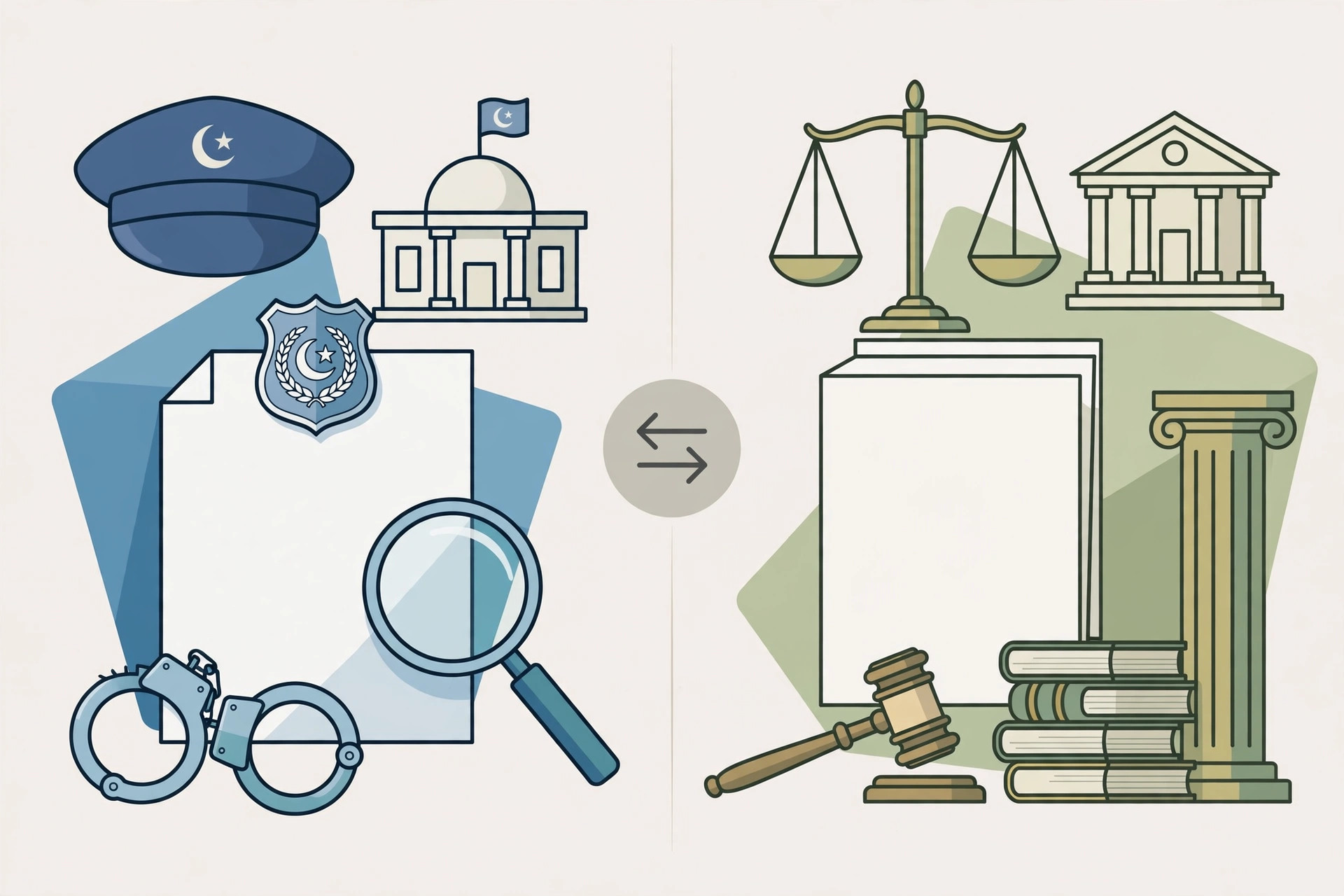
Short answer: An FIR (First Information Report) is a report made to the police about a cognizable offence, which sets the police investigation in motion. A private complaint is a complaint made directly to a magistrate, asking the magistrate to take action, and it is used mainly when the police do not act, or when the offence is non-cognizable. Both are legitimate ways to start a criminal case, but they follow different procedures.
What is an FIR? Under Section 154 of the Code of Criminal Procedure, 1898, when information about a cognizable offence is given to the officer in charge of a police station, that information must be reduced to writing, read over to the informant, signed by the informant, and entered in a book kept for that purpose — the FIR book. A copy must be given free of cost to the informant. The FIR is not a final verdict and it is not proof that the accused committed the offence; it is simply the first information that sets the criminal law in motion. Once an FIR is registered, the police investigate: they visit the place of occurrence, record statements of witnesses under Section 161 CrPC, collect evidence, and arrest the accused if the law permits. After investigation, the police submit a report under Section 173 CrPC, commonly called the challan, either sending the accused up for trial or reporting that the case is untraced or that the accused are innocent. The FIR route is the normal route for serious offences such as murder, robbery, theft, kidnapping, rape, and serious assault, because the police have the power to investigate these offences on their own.
What is a private complaint? A private complaint is a complaint made directly to a magistrate under Section 200 CrPC. The complainant appears before the magistrate, the magistrate examines the complainant on oath, and the magistrate may then either issue process against the accused, order an inquiry or investigation, or dismiss the complaint if it discloses no offence. A private complaint is particularly important in two situations. First, for non-cognizable offences — offences where the police cannot investigate or arrest without a magistrate's order — the complaint route is often the only way to proceed. Second, when the police refuse to register an FIR, or register it but do not investigate properly, the aggrieved person can approach the magistrate directly with a private complaint, or can approach the Justice of the Peace or the High Court for a direction to the police to register an FIR. A private complaint is also used for offences that are tried on complaint, such as defamation, where the law requires the aggrieved person to come forward personally.
What are the practical differences? The first difference is who you approach: for an FIR you go to the police station; for a private complaint you go to the magistrate's court, usually through a lawyer. The second difference is who investigates: in an FIR case the police investigate; in a private complaint case the magistrate may conduct an inquiry, direct the police to investigate under Section 202 CrPC, or proceed on the complainant's evidence. The third difference is control: in an FIR case the State, through the police and the prosecutor, largely runs the prosecution, although the complainant remains an important witness and can engage a lawyer to assist the prosecution; in a private complaint case the complainant plays a more active role in prosecuting the case, although the court can still take over or the prosecutor can intervene in appropriate cases. The fourth difference is cost and effort: registering an FIR is free, while a private complaint involves court fees and usually a lawyer's fee, and it requires the complainant to attend court hearings more actively.
Which route should you choose? If you are the victim of a serious, cognizable offence, go to the police station first and try to register an FIR, giving a clear, truthful, and complete account of what happened, with names, dates, places, and the names of witnesses. Take a copy of the FIR and note the FIR number, the police station, and the investigating officer's name. If the police refuse to register the FIR, do not argue at the station and do not pay a bribe: instead, send a written application to the District Police Officer or the Superintendent of Police, and consult a lawyer about approaching the Justice of the Peace under Section 22-A CrPC for a direction to register the FIR, or filing a private complaint before the magistrate. If your matter is a non-cognizable offence, or if it is a complaint-based offence such as defamation, go directly to a lawyer and discuss a private complaint. In either route, act promptly: delay in reporting a crime is always questioned in court, so if there is a reason for delay, such as illness, fear, or distance, explain it honestly in your FIR or complaint.
Common misunderstandings. An FIR is not a conviction, and a person named in an FIR is presumed innocent until proved guilty. A private complaint is not a weaker remedy — courts take private complaints seriously, and many cases that the police ignored have succeeded as private complaints. Conversely, filing a false FIR or a false complaint is itself an offence and can lead to prosecution and to a civil claim for damages, so never exaggerate or invent facts. Give only facts you personally know, distinguish between what you saw and what you heard from others, and let the investigation and the court decide the rest.
The Bottom Line
This article provides general legal information for readers in Pakistan and is not legal advice. For advice about your own situation, consult a qualified advocate.