
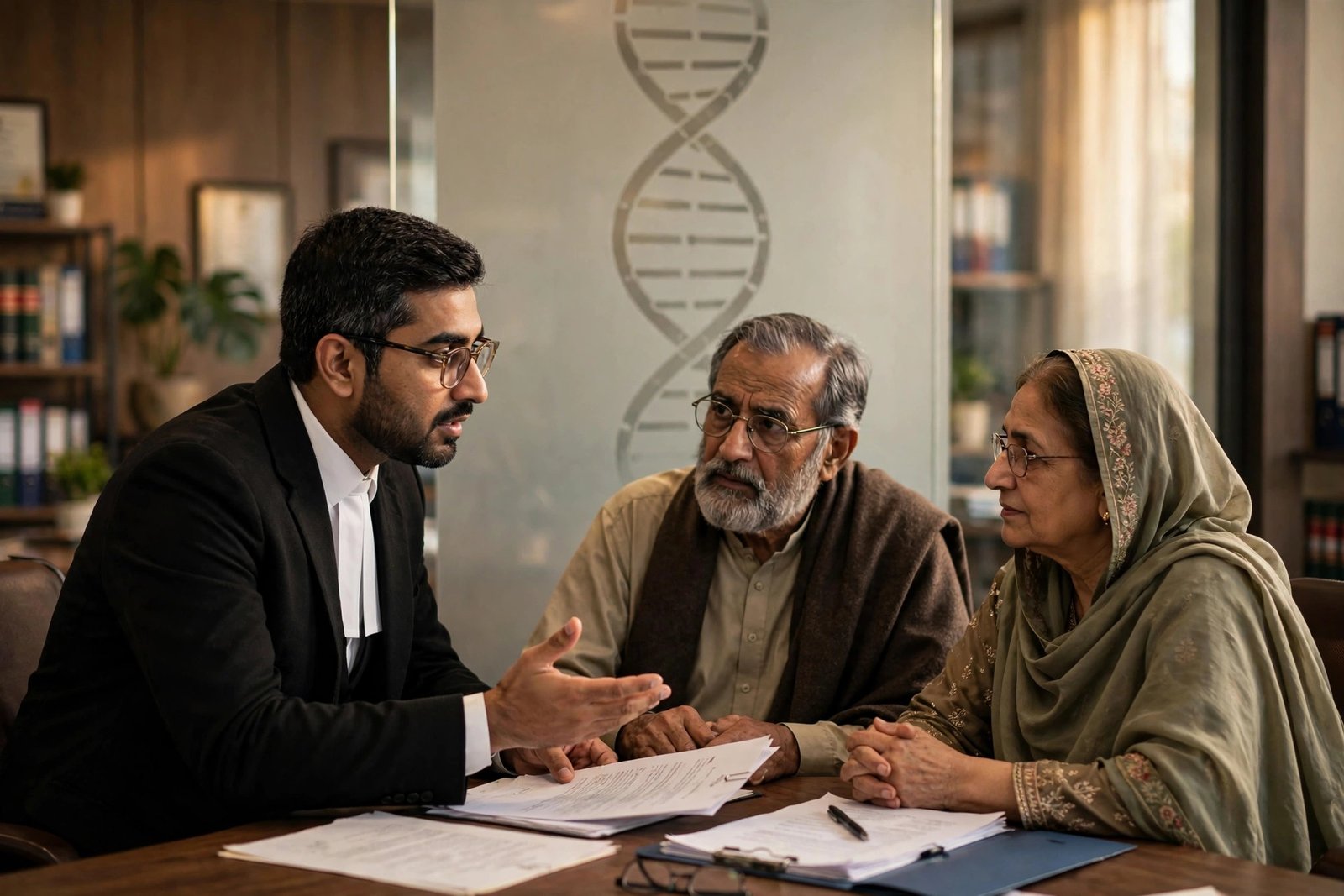
Quick answer: On September 30, 2026, the Supreme Court of Pakistan held that a DNA test conducted on distant or indirect relatives cannot, by itself, reject a person's paternity or inheritance claim. Such DNA only shows a statistical probability, not a definite answer, and the court must weigh it together with all other evidence. Birth during a valid marriage remains conclusive proof of legitimacy under Article 128 of the Qanun-e-Shahadat Order, 1984.
What did the Supreme Court actually decide on September 30, 2026?
A three-member bench of the Supreme Court — Justice Muhammad Ali Mazhar, Justice Irfan Saadat Khan, and Justice Shahid Bilal Hassan — heard a petition by Barkat Khan and others against a Peshawar High Court (Abbottabad Bench) decision. The petitioners were challenging a long-running inheritance dispute. They dismissed the petition. Case over.
Now, why did this matter? Because the petitioners had one central weapon in their armoury: a DNA test. Not a DNA test of the father and the alleged son, mind you. A DNA test of extended family members — distant relatives. Their argument was simple: this DNA report disproves that the plaintiffs belong to the deceased's lineage, so the inheritance claim should fail.
The Supreme Court looked at that argument and said, in effect: that is not how DNA evidence works.
The Court held that DNA collected from indirect or distant relatives carries low evidentiary weight. It gives you a statistical probability at best. It does not give you a definite, conclusive answer about paternity. And — this is the crucial part — it cannot be used on its own to knock down a paternity or inheritance claim. The judge must consider it alongside everything else: documents, records, and the surrounding evidence.
What was the actual case behind this judgment?
Understanding the facts helps. Let me lay it out plainly, because inheritance disputes in Pakistan almost always follow the same pattern.
On December 14, 2007, Banaras Khan and others filed a suit claiming to be the legal heirs of Muhammad Ayub Khan, who had died on October 10, 2006. They wanted their share of his property — the usual virasat dispute. The trial court dismissed their suit on July 13, 2011. Then the appellate court reversed that decision and decreed the suit in favour of the plaintiffs on December 11, 2012. A revision went to the Peshawar High Court, which dismissed it on February 22, 2021. And then, years later, the petitioners came to the Supreme Court.
That's nearly nineteen years of litigation. Let that sink in. A family spent almost two decades in courtrooms — district court, appellate court, High Court, Supreme Court — fighting over who inherits a deceased man's property.
Now, the petitioners' trump card was the DNA report from distant relatives. They said: this science proves the plaintiffs are not really the descendants. The Supreme Court's answer was unambiguous. A distant relative's DNA report is not proof of paternity. It is, at best, an estimate of likelihood — "mere statistical probability," in the Court's own words — and probability is not proof.
Meanwhile, the respondents had something the petitioners couldn't wave away: paper. NADRA records. A death certificate issued by the Union Council Dhamtour. Photographs of graves. Marriage agreements that clearly listed Arsala Khan as the father of Muhammad Ayub Khan. One after another, the documentary evidence lined up. The Court gave that the weight it deserved.
Why does DNA from distant relatives carry low weight?
This is where people get confused, so let me break it down simply.
A direct father-child DNA test — where you test the father and the child — compares samples from the two people whose relationship is in question. The science there is extremely reliable. Nobody disputes that, and the Supreme Court didn't either.
But a distant relative's DNA test works differently. Suppose the person whose paternity is in question is dead — as Muhammad Ayub Khan was here. You can't test him directly. So someone tests, say, a cousin, or an uncle from another branch of the family, and tries to extrapolate: "If these people don't match me genetically, then the deceased wasn't my father."
That extrapolation is the problem. Genetic markers get diluted across generations and across branches of a family tree. The further the relative, the weaker the inference. A mismatch with a distant relative might mean there is no blood relationship — or it might mean nothing at all, because the genetic distance was too great to yield a meaningful answer either way. That is why the Court called it "mere statistical probability, not definitive proof."
Ask yourself this: would you let someone be disinherited — stripped of their father's property — because of a probability? That's the question the Court answered. And its answer was no.
What is Article 128 of the Qanun-e-Shahadat Order, 1984, and why does it matter?
This is the backbone of the whole judgment. Article 128 says something very powerful: if a child is born during a valid marriage, the law treats that child as legitimate. Conclusively. Not "probably." Not "unless someone brings a lab report." Conclusively.
This is an old principle, and it exists for good reason. The law doesn't want every inheritance to become a genetics experiment. It wants stability in families and in property titles. Imagine if every property dispute in Pakistan could be reopened because someone, thirty years later, decides to question somebody's parentage. The chaos would be endless. Article 128 draws a line: a child born in a lawful marriage is legitimate, and no one gets to casually erase that status with an indirect DNA test.
Now, there is a subtle point here that confuses even some lawyers. Article 128's conclusive presumption of legitimacy is not the same thing as saying DNA is useless. Direct DNA evidence — a father-child test — is still admissible in many circumstances, and courts do order it. But the presumption sets the bar high: you can't defeat legitimacy on thin science. You need evidence of real weight, examined together with everything else on the record.
So, can a court still order a DNA test in an inheritance dispute?
Yes — but within limits. Let me spell them out.
Direct DNA tests remain powerful evidence. If the alleged father is alive (or his body is available for sampling) and a court orders a father-child DNA comparison, that result is conclusive-grade evidence. The 2026 judgment does not touch that. It only deals with indirect DNA — tests on people who are not the alleged father himself.
Courts can order DNA tests, but they must weigh them properly. The Supreme Court's message to judges was clear: when a DNA report from distant relatives is placed before you, don't treat it as a verdict. Weigh it with the documentary evidence — NADRA records, Union Council certificates, nikah namas, mutation entries, and the like. The complete picture decides, not one lab report.
You cannot use indirect DNA to bypass Article 128. If someone was born during a valid marriage, a distant relative's DNA report is not going to defeat that conclusive presumption. Full stop.
When trial and appellate courts disagree, the High Court must look at everything. That was another point in the judgment: where the trial court dismissed the suit and the appellate court decreed it, the revisional court (here, the Peshawar High Court) has to examine the complete record — not cherry-pick. That principle matters for anyone whose case is bouncing between courts.
What does this mean for your own virasat case?
Let me be practical. Most inheritance disputes in Pakistan are not about DNA at all. They're about documents, possession, and family pressure. But every now and then, someone raises the DNA card — usually to intimidate the other side. Here's what the 2026 judgment means for you.
If you are claiming your share: gather your documents first, genetics later. The respondents in this case won because they had NADRA records, a Union Council death certificate, grave photographs, and marriage agreements naming the father. Paper beat probability. Your case works the same way — if you want to know how to formally secure your share, see our guide on property inheritance law in Pakistan.
If the other side threatens you with a DNA test: ask a simple question — whose DNA? If they're offering to test a distant relative rather than the alleged father, this judgment says that report carries low weight. Don't let a "we'll do a DNA test" threat scare you out of your legitimate claim. That's intimidation, not evidence.
If you are thinking of ordering a DNA test yourself: spend the money wisely. A direct test of the alleged father (if alive) or properly identified remains is what you want. Testing yourself against some distant cousin and hoping to prove a lineage is, in the Supreme Court's words, statistically weak. Know what you're buying before you pay for it.
Don't wait nineteen years. This case ran from 2007 to 2026. The parties who started it are probably old now, and some may not be alive. In inheritance matters, delay is the biggest destroyer of rights — records get lost, witnesses die, and positions harden. If you have a claim, act on it. File the suit. Get the succession certificate from NADRA. Move the mutation (intiqal) in the revenue record. Rights you don't assert tend to evaporate.
How do courts weigh DNA against documents? A practical picture
Mere tajurbe me aksar yahi hota hai: log samajhte hain ke court me sab se mazboot cheez "science" hoti hai. Haqeeqat yeh hai ke court sab se zyada bharosa mustanad kagaz par karta hai. A judge in a civil court in Abbottabad or Lahore will ask, in plain terms: who has the better record?
Here's roughly how a court stacks things up in an inheritance dispute:
- Civil records first. NADRA family registration certificates, birth and death certificates from the Union Council, the nikah nama — these carry serious weight. They were created contemporaneously, often decades ago, by state institutions.
- Revenue and property records. Mutation entries, fard, registry documents showing the deceased's name and the heirs who derived title. If the revenue record has been showing someone as the heir for years, that's a strong signal.
- Family documents. Marriage agreements (like the ones in this very case that named Arsala Khan as Muhammad Ayub Khan's father), family trees maintained over generations, photographs.
- Oral and witness evidence. Neighbours, relatives, community elders who can speak to the family relationships.
- Scientific evidence like DNA. Admissible, yes — but slotted into the overall picture, and weighted according to its type. Direct father-child DNA is heavy. Distant-relative DNA is light. That's the Supreme Court's taxonomy now.
Notice what's missing from that list? "A single test report that decides everything." Courts don't work like TV dramas. Evidence is a basket, not a bullet.
Common mistakes people make in paternity and inheritance disputes
After seeing how these disputes play out year after year, I can tell you the mistakes that keep repeating. Avoid them.
Mistake 1: Relying on a DNA report alone. This is exactly what the petitioners in this case did — they put almost all their eggs in the DNA basket and neglected the documentary war. The basket had a hole in it. Never go into an inheritance fight with one piece of evidence. Build a case, not a gimmick.
Mistake 2: Treating a threat of DNA as the end of your case. Aksar log ye ghalti karte hain: doosra fareeq kehta hai "hum DNA karwa lenge" aur woh ghabra kar samjhota kar lete hain. Now you know better. Indirect DNA carries low evidentiary weight. Don't surrender your share to a threat.
Mistake 3: Ignoring Article 128. Many people — and frankly, some lawyers — don't realise how strong the legitimacy presumption is. If you were born during a valid marriage, your legitimacy is conclusively presumed. Someone can't just "question" it into existence. They need real, weighty evidence.
Mistake 4: Not getting documents early. In this case, the winning side had NADRA records, a Union Council death certificate, and marriage agreements. Where do you think those came from? From someone who kept documents safe for years. Get your NADRA family tree corrected now. Get the death certificate from the Union Council now — it costs a few hundred rupees. Dig out the nikah nama. Don't wait for a dispute to start looking for paper.
Mistake 5: Letting the case drag across courts. Trial court, appellate court, High Court revision, Supreme Court — nineteen years. Some delay is unavoidable, but a lot of it comes from incomplete records and poor preparation at the trial stage. Put your best evidence in at the very first court. An appellate judge decides on the record the trial court made. A weak trial record is a handicap you never recover from.
Mistake 6: Forgetting the sisters. In far too many of these disputes, the real injustice is that women in the family are pushed out of the inheritance entirely while male cousins fight over the leftovers. If you're a daughter or sister in the family, your share is your Islamic and legal right — it doesn't vanish because the men are busy fighting. Read our piece on inheritance rights of sisters in Pakistan and claim what is yours.
Documents checklist: what to gather before any DNA discussion
Before anyone talks about DNA, get your documentary house in order. Here's the practical checklist — the same categories of evidence that decided the 2026 Supreme Court case:
- NADRA Family Registration Certificate (FRC) of the deceased and of the claimants. If the names don't line up, apply for correction now — a NADRA correction case takes 4–8 weeks through the proper channel.
- Death certificate of the deceased from the relevant Union Council (in this case, Union Council Dhamtour). Costs very little, takes a few days.
- Birth certificates of the claimants showing parentage.
- Nikah nama of the deceased's marriage — this is what anchors the Article 128 presumption of legitimacy.
- Marriage agreements or family documents naming lineage (the respondents' marriage agreements listed Arsala Khan as the father of Muhammad Ayub Khan — and it mattered).
- CNIC copies of the deceased and all heirs.
- Property documents: registry, fard-e-malkiat, mutation (intiqal) entries showing the chain of ownership.
- Succession certificate from NADRA (for movable property and bank accounts) — see our step-by-step guide on getting a succession certificate from NADRA.
- Photographs of family events and graves — yes, really. The respondents in this case produced photographs of graves, and the Court counted them as part of the evidentiary picture. Photographs don't lie easily.
- Witness list: elderly relatives, neighbours, and community members who can speak to the family relationships. Get their names and CNIC numbers ready for the trial court.
Total cost of gathering most of this? A few thousand rupees and a few weeks of running around. Compare that with a DNA test (Rs. 30,000–60,000 in private labs) that may carry "low evidentiary weight" in court. Spend where it counts.
When should you actually insist on a DNA test?
To be fair — DNA isn't useless. There are situations where it's genuinely the right tool.
When the alleged father is alive and denies paternity. A direct father-child DNA test here is decisive. If someone says "I am not your father" while standing right there, a direct test settles it. This judgment doesn't weaken that one bit.
When the body is available and identifiable. Exhumation for DNA sampling is legally possible through court orders, though it's rare and sensitive. If ordered properly, the result is direct evidence.
When there's a genuine, narrow question of identity. Switched-at-birth claims, hospital mix-ups — situations where the question is really "is this the right person?" rather than a decades-old lineage dispute. Direct DNA is made for those.
When you want it as one piece among many. Even in a case like this one, a DNA report isn't inadmissible — it's just light. If you have it, produce it, but produce it with your documents, not instead of them.
What you should NOT do: spend Rs. 50,000 testing yourself against a third cousin, walk into court with that report alone, and expect to rewrite a family's lineage. The Supreme Court has now said, plainly, that this is not how it works.
FAQs
Does this judgment mean DNA tests are useless in Pakistani courts? No — not at all. The judgment is specifically about DNA from distant or indirect relatives. A direct father-child DNA test remains conclusive-grade evidence, and courts order DNA tests regularly. What the Court rejected was the idea that a distant relative's DNA report, on its own, can defeat a paternity or inheritance claim.
I was born during my parents' marriage. Can anyone challenge my legitimacy with a DNA test? Article 128 of the Qanun-e-Shahadat Order, 1984 gives you a conclusive presumption of legitimacy. That is a very strong shield. Someone challenging it would need evidence of real weight — not a distant relative's DNA report. If you're facing this kind of challenge, see a lawyer early; the presumption works in your favour, but you still have to assert it properly in court.
My cousins are refusing my share, claiming I'm not really from the family. What should I do? Gather your documents first — NADRA FRC, your birth certificate, your father's death certificate, the nikah nama. Then consult a lawyer about filing a suit for declaration and possession. If the cousins threaten a DNA test, remember: unless they're testing the alleged father himself, that report carries low weight. Don't let the threat push you into an unfair compromise.
Can the court force me to give a DNA sample? Courts can order DNA tests in appropriate cases, but they exercise this power carefully — especially when it involves dignity and privacy concerns. A court won't order a fishing expedition. There must be a genuine, relevant question that the test would actually answer. An order to test a distant relative to "disprove" someone's lineage is far less likely after this judgment.
The deceased died years ago. Can DNA still be done? Possibly, through court-ordered exhumation and sampling — but it's a difficult, sensitive, and expensive route that courts allow only in exceptional circumstances. In most cases, the documents listed in the checklist above will decide the dispute long before anyone gets to that stage. Paper is almost always the better fight.
What if the DNA report says "excluded" — doesn't that prove anything? An exclusion in a direct father-child test is powerful. An exclusion based on a distant relative's sample is exactly what the Supreme Court addressed: it reflects statistical probability, not definitive proof, and it must be weighed with all other evidence. One lab report doesn't override NADRA records, a Union Council death certificate, and marriage agreements pointing the other way.
How long do inheritance suits take in Pakistan? Honestly? Years. The case behind this judgment started in December 2007 and ended at the Supreme Court in 2026 — nineteen years. Most cases aren't that extreme; a straightforward declaration suit with good documents can conclude at the trial and appellate stage in 3–6 years. The lesson is to start early, prepare your documents before filing, and put your full case in at the trial court.
Can sisters be cut out of inheritance using a paternity challenge? No — and attempts to do so are unfortunately common. A daughter's legitimacy is protected by the same Article 128 presumption, and her Islamic share is a separate, settled right. Paternity games aimed at excluding women from virasat don't get special treatment from courts. If this is happening in your family, document everything and seek legal help promptly.
Does this judgment apply to cases already pending in court? Supreme Court judgments on questions of law apply to pending cases as guiding authority. If your pending inheritance dispute involves a distant-relative DNA report, this judgment directly governs how the court must weigh it. Show it to your lawyer — it may change how your case is argued.
What's the single most important thing to do in an inheritance dispute? Secure the documents before the fight starts. NADRA records, the Union Council death certificate, the nikah nama, the property papers. In the 2026 case, the side with the paper won against the side with the lab report. That pattern repeats in courtrooms across Pakistan every single day.
The bottom line
The Supreme Court's September 30, 2026 judgment is a common-sense ruling dressed in legal language. It says: you cannot erase a person's father — and with him, their inheritance — on the basis of a lab report about somebody else's DNA. Direct DNA evidence still counts. Article 128 still protects children born in valid marriages. And when judges weigh evidence, the whole record decides: NADRA files, Union Council certificates, marriage agreements, and yes, photographs of graves.
If you're in the middle of a virasat dispute, the takeaway is refreshingly old-fashioned. Keep your documents safe. Know your rights. Don't be bullied by scientific-sounding threats. And get proper legal advice before the dispute hardens into a nineteen-year war.